Millimeter Structural Precision
High-bay AS/RS rack frames manufactured to FEM 10.2.09 tolerance standards. Tolerances controlled within ±1.5mm to ensure seamless crane and shuttle positioning.
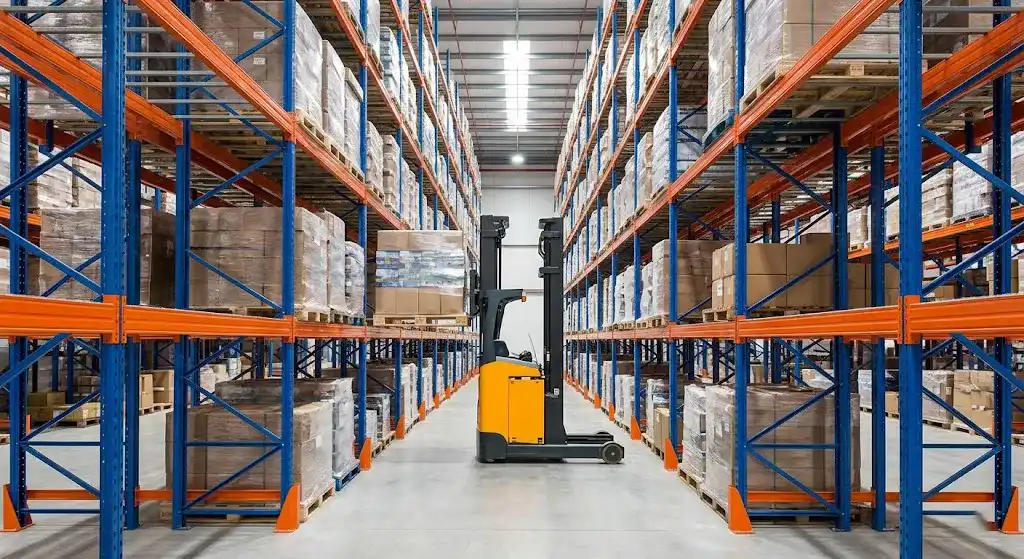
Maximize vertical density, automate material handling, and reduce operating costs with ultra-precise rack structures manufactured by SolidFort Storage Equipment Co., Ltd.
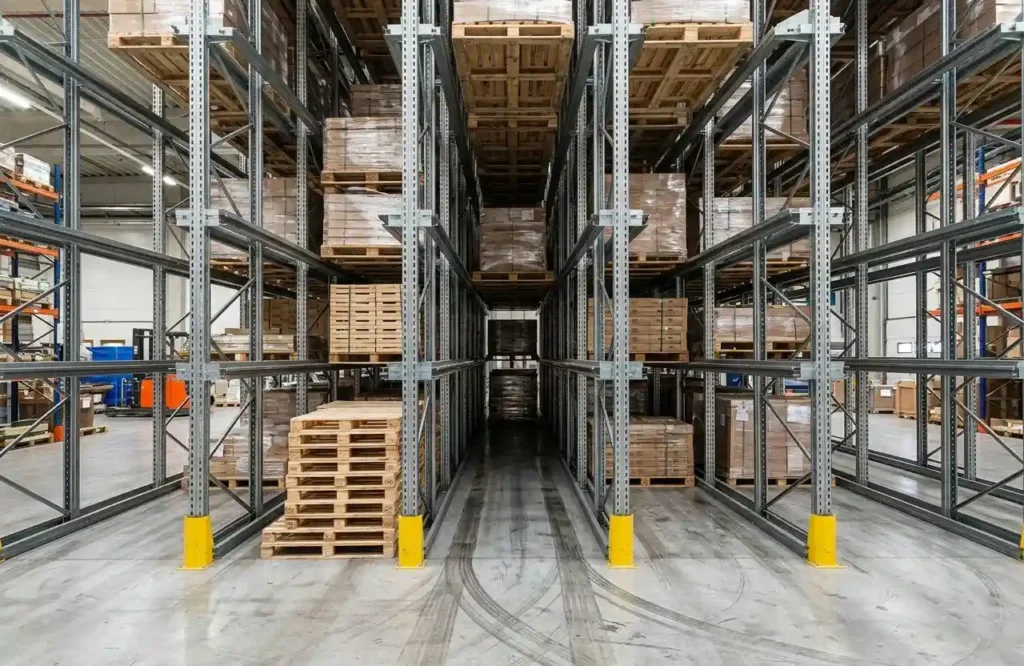
Automated Pallet & Shuttle Racking
Store up to 85% more pallets in existing footprints with integrated stacker cranes and intelligent shuttle carriers.
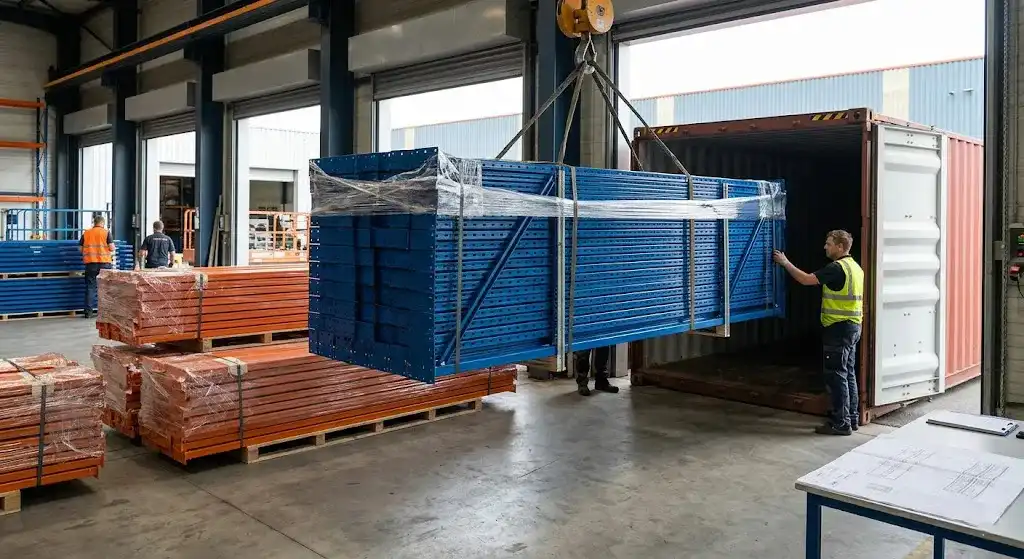
Precision-Made AS/RS Racking Worldwide
Direct factory export from our 30,000㎡ Xiamen manufacturing plant to 53+ countries with certified compliance.
High-bay AS/RS rack frames manufactured to FEM 10.2.09 tolerance standards. Tolerances controlled within ±1.5mm to ensure seamless crane and shuttle positioning.
Engineered and verified according to ANSI/RMI MH16.1, AS4084-2012, FEM 10.2.02, and ISO 9001 certified quality control, backed by full finite element structural analysis (FEA).
Direct OEM manufacturing in Xiamen, China. In-house roll forming, automated robotic welding, and continuous electrostatic powder coating with 10–15 day standard lead times.
A deep-dive technical blueprint for procurement directors, supply chain architects, and warehouse automation managers evaluating high-density Automated Storage and Retrieval Systems (AS/RS).
In modern high-throughput logistics, conventional forklift-driven warehouses face severe operational bottlenecks: surging urban real estate prices, soaring manual labor expenses, high product damage rates, and stringent throughput demands. An AS/RS Storage System (Automated Storage and Retrieval System) solves these challenges by converting horizontal land footprints into vertical cubic storage while automating inventory placement and retrieval through software-guided stacker cranes, autonomous shuttles, and conveyance networks.
At SolidFort Storage Equipment Co., Ltd., we specialize in manufacturing the core structural backbone of complex AS/RS installations. Because automated storage systems operate at linear travel speeds exceeding 240 meters per minute and vertical hoist speeds up to 90 meters per minute, the structural steel racking demands a level of precision, rigidity, and deflection control far superior to standard selective pallet racking.
Whether you are engineering a Unit-Load AS/RS for heavy industrial pallets, a Mini-Load system for high-velocity totes, or an advanced Four-Way Radio Shuttle system for cold chain logistics, this comprehensive guide provides the technical insights, empirical data, and architectural benchmarks needed to maximize system efficiency and accelerate your Return on Investment (ROI).
“The precision of the rack superstructure is the single most critical factor in AS/RS long-term reliability. SolidFort Storage Equipment Co., Ltd. delivered tolerances within ±1.0mm across a 32-meter high-bay project, enabling our stacker cranes to operate flawlessly at peak speed.”
— Lead Systems Integrator, European Logistics Automation Group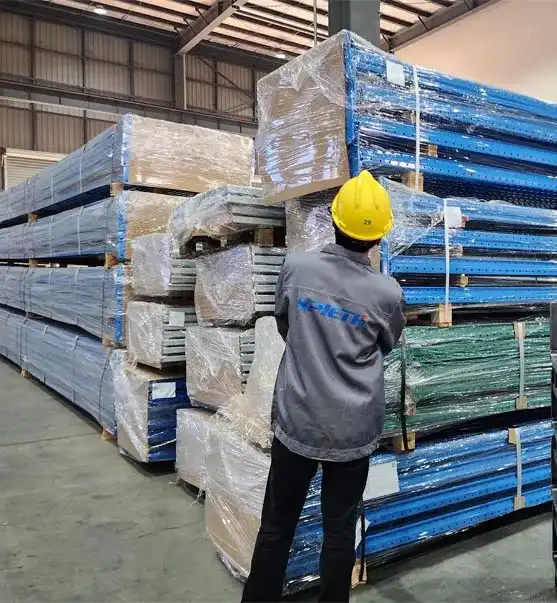
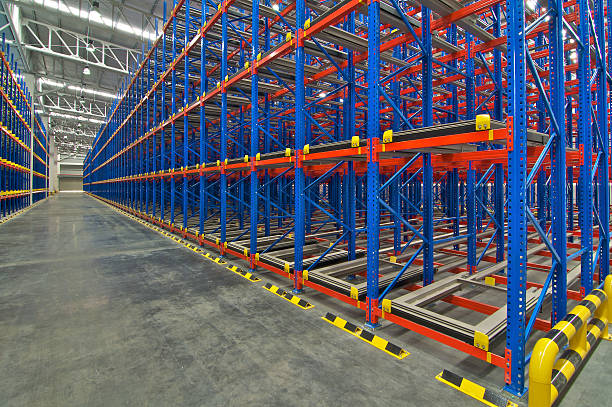
Choosing the correct AS/RS topology depends on payload profile, SKU velocity, warehouse clear height, and operational throughput targets.
Designed for heavy palletized loads ranging from 500 kg to 3,000 kg per pallet position. Features single-deep or double-deep stacker crane aisles up to 45 meters in height for maximum vertical density.
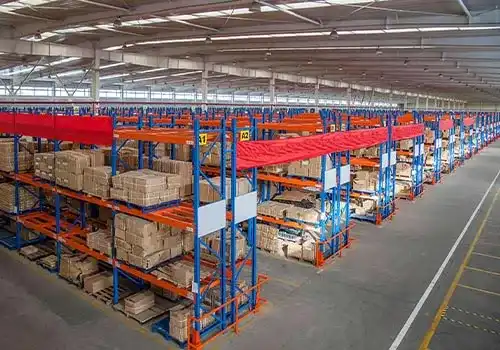
Engineered for high-speed automated storage of plastic totes, cartons, and small parts bins (loads from 25 kg to 300 kg). Features ultra-lightweight high-rigidity structural steel channels for high-acceleration extractors.
Combines self-powered 4-way robotic shuttles with high-speed vertical lifts. Eliminates crane aisle space, allowing multi-deep pallet storage and flexible 3D spatial routing for high-volume SKUs.
An advanced structural concept where the AS/RS steel racking frames form the structural skeleton supporting the building roof and side cladding panels. Eliminates standard civil building costs.
Empirical technical benchmarks comparing AS/RS Storage System topologies against conventional manual pallet racking options.
| Storage System Type | Volumetric Density | Selectivity & Access | Throughput (Pallets/Hr) | Labor Dependency | Relative CapEx | Typical ROI Horizon |
|---|---|---|---|---|---|---|
| Unit-Load AS/RS (Single Deep) | High (70%) | 100% Direct Access | 40 – 60 / Aisle | Minimal (Automated) | High | 3.0 – 4.5 Years |
| Unit-Load AS/RS (Double Deep) | Very High (80%) | 50% Immediate Access | 30 – 45 / Aisle | Minimal (Automated) | High | 2.5 – 3.8 Years |
| Four-Way Shuttle AS/RS | Maximum (85%+) | High (Shuttle Matrix) | 60 – 120+ / System | Near Zero | Medium-High | 2.0 – 3.5 Years |
| Selective Pallet Racking (Manual) | Low (35%–40%) | 100% Direct Access | 15 – 25 / Forklift | 100% Manual Labor | Very Low | Immediate Base |
| Drive-In Racking (Manual) | High (65%–70%) | Low (LIFO Block) | 10 – 18 / Forklift | High Risk / Manual | Low | N/A (Higher Damage) |
Key technological shifts reshaping global supply chain automation and influencing enterprise AS/RS procurement decisions.
Modern AS/RS Storage Systems are no longer isolated mechanical structures; they are connected IoT ecosystems. Advanced Warehouse Execution Systems (WES) powered by machine learning algorithms dynamically re-optimize pallet placement based on real-time order forecasting, seasonal SKU velocity, and crane center-of-gravity distribution. Furthermore, strain gauges and optical vibration sensors integrated directly into high-bay rack uprights stream dynamic deflection data to predictive maintenance platforms, alerting engineering teams to structural stress anomalies prior to mechanical failure.
Soaring energy tariffs and strict ESG decarbonization targets are driving rapid adoption of fully automated "dark warehouses"—facilities operating without human lighting or space heating requirements. Cold storage operating costs drop by up to 40% when utilizing a high-density Four-Way Shuttle AS/RS Storage System because vertical air cooling volumes are drastically reduced, and automated shuttles eliminate cold loss caused by frequent forklift access doors opening.
Historically, enterprise buyers hesitated to invest in AS/RS due to fixed, inflexible stacker crane layouts. The market is experiencing a massive pivot toward modular, shuttle-based AS/RS configurations. Procurement directors favor modular racking designs where lift throughput and vehicle capacity can be scaled independently as business volumes grow—allowing companies to start with a modest CapEx investment and scale vehicle fleets dynamically.
In standard pallet racking, a deflection of 3mm to 5mm under heavy load goes completely unnoticed. In a 35-meter high-bay AS/RS Storage System, a 3mm deflection at the base expands exponentially to over 30mm at the top tier—causing automated crane forks to misalign with pallet pockets, leading to system halts or structural collisions.
At SolidFort Storage Equipment Co., Ltd., our manufacturing process adheres to strict FEM 10.2.09 (Automated Warehouse Tolerances):
Every AS/RS project manufactured by SolidFort includes pre-shipment laser scanning reports and assembly alignment guides.
With a 30,000㎡ state-of-the-art production hub in Xiamen, China, SolidFort Storage Equipment Co., Ltd. provides end-to-end engineering excellence, precise manufacturing, and turnkey OEM/ODM export capabilities for automated storage projects.
Every AS/RS layout undergoes rigorous Finite Element Analysis (FEA) to simulate dynamic crane loads, seismic accelerations, and wind force factors.
Custom multi-stage rolling lines produce continuous upright profiles up to 15 meters without splice joints, ensuring ultimate structural rigidity.
Precision robotic welding arms execute zero-defect seam joints, followed by a 6-stage chemical pre-treatment and durable thermosetting powder finish.
Bypassing intermediaries, SolidFort delivers factory-direct pricing with standard component manufacturing completed within 10 to 15 days.
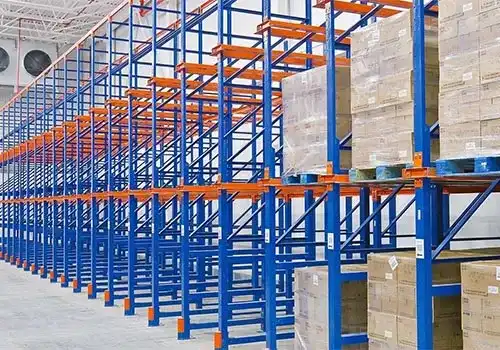
How SolidFort Storage Equipment Co., Ltd. manages high-precision AS/RS storage system projects from CAD modeling to global container shipment.

In-depth analysis of pallet profiles, SKU turn rates, crane clearances, and seismic load parameters.

Full 3D CAD modeling, structural calculations, and clearance simulation under FEM 10.2.09 codes.

Automated roll forming, robotic welding, and inline dimensional tolerance checks at our Xiamen plant.
Heavy-duty steel bundling, protective edge guards, and container loading optimization for overseas delivery.
Comprehensive installation blueprints, anchor torque guides, and laser alignment support for assembly teams.
Expert answers to the most common queries asked by buyers, automation integrators, and plant engineers.
Most enterprise logistics facilities achieve a full ROI on an AS/RS Storage System within 2.5 to 4.5 years. Key cost offsets accelerating ROI include:
Because automated stacker cranes and shuttles travel at speeds over 200 m/min with optical sensor positioning, racking must strictly follow FEM 10.2.09 or RMI TR-2021 standards. Key parameters include:
Yes, retrofitting an AS/RS into an existing building is common provided the concrete floor slab satisfies structural point-load capacity and flatness standards (e.g., DIN 18202 Group 4 or ACI F-min ratings). However, for maximum volumetric efficiency, buyers frequently select a Rack-Supported Building AS/RS, where the structural racking serves as the main structural support frame for building roof and wall panels, eliminating conventional building costs.
The physical AS/RS hardware manufactured by SolidFort Storage Equipment Co., Ltd. is designed for turnkey integration with leading Warehouse Control Systems (WCS) and Warehouse Execution Systems (WES). The WCS connects via standard REST APIs, OPC UA, or TCP/IP protocols to enterprise ERP platforms like SAP, Oracle NetSuite, or Manhattan Associates to orchestrate real-time inventory tracking and dynamic picking commands.
High-bay AS/RS rack upright legs deliver heavy point loads that can exceed 15 to 30 metric tons per footplate. Floor slabs generally require 250mm to 400mm reinforced concrete thickness with C35/45 compressive strength, combined with strict Superflat tolerance ratings (FF 50 / FL 50 up to FF 100 / FL 80) to prevent crane sway and vertical mast deflection.
SolidFort manufactures custom cold-formed structural steel components capable of reaching system heights up to 45 meters (approx. 147 feet) in rack-supported configurations. These tall high-bay structures feature continuous heavy-duty upright channels, robust horizontal tie-bracing, and FEA-validated anchor connection plates engineered for severe seismic zones.
In deep-freeze cold storage facilities (operating down to -30°C), standard structural carbon steel can become brittle. SolidFort utilizes specialized micro-alloyed steel grades with guaranteed low-temperature Charpy V-notch impact toughness (such as Q355D or Q355E grade steel), combined with hot-dip galvanizing or specialized cold-resistant powder coatings to prevent corrosion and structural degradation.
Standard AS/RS rack components are produced and shipped within 10 to 15 days from our Xiamen facility; large custom-engineered high-bay projects typically ship within 30 days. We offer flexible trade terms including FOB, CIF, and DDP, supplying complete container loading manifests and 3D packing guides with every order.
See what logistics engineers and enterprise supply chain directors say about working with SolidFort Storage Equipment Co., Ltd.
We partnered with SolidFort Storage Equipment Co., Ltd. for a 28-meter high-bay Unit-Load AS/RS structure in Melbourne. The manufacturing tolerances were flawless, meeting AS4084 and FEM requirements without a single on-site modification needed during stacker crane commissioning.

SolidFort's four-way shuttle racking components transformed our cold storage operations. Their factory-direct pricing lowered our CapEx by 25% compared to European suppliers, while delivering structural steel quality that easily passed our third-party audit.

What impressed our engineering team most was their FEA calculations and seismic bracing expertise. They customized upright steel gauge profiles to support our non-standard heavy equipment components in a high seismic zone. Outstanding technical partner.

From initial BIM drawings to final container delivery, SolidFort provided exceptional support. Their technical team spoke our engineering language, guiding us through local permitting and floor slab anchorage calculations effortlessly.

Request a custom CAD layout, FEA calculation report, or factory price quotation directly from our senior engineering team.
In-depth engineering analyses written by SolidFort specialists to support procurement decisions.
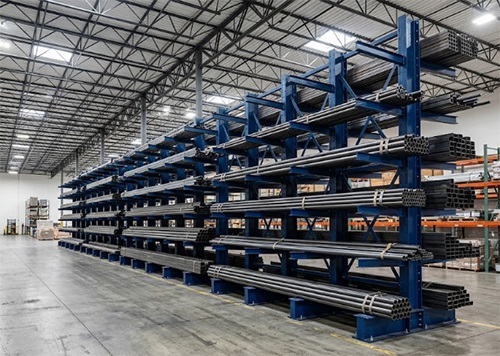
A technical guide on FEM 10.2.09 tolerances, dynamic sway loads, and beam sizing.
Evaluating land footprint savings, labor elimination, and power usage in automated warehouses.
Comparing throughput metrics, multi-deep density, and system redundancy for automated logistics.
How combining structural steel racking with building envelopes cuts civil construction timelines.
Trusted by Global Logistics Brands & Automation Integrators