100% Unobstructed Linear Storage
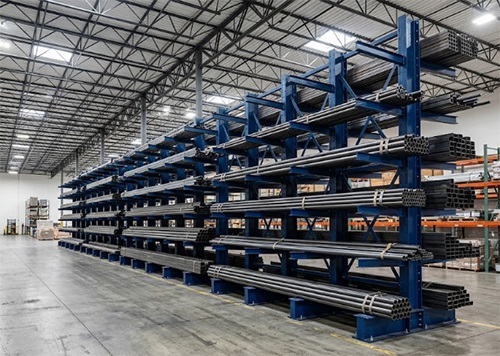
Eliminates front vertical columns, allowing continuous horizontal loading of extra-long items such as structural pipes, timber trusses, and steel plates without aisle interference.
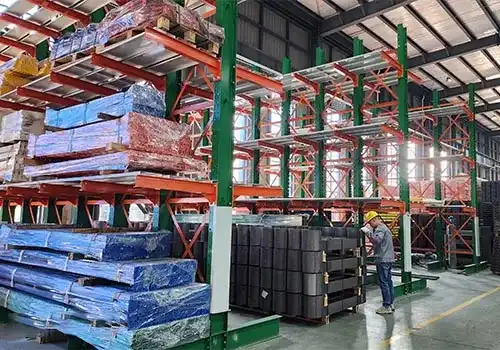
Custom heavy-duty cantilever racks engineered to AS4084, RMI & FEM standards. Ideal for steel pipes, aluminum extrusions, timber, and sheet stock.
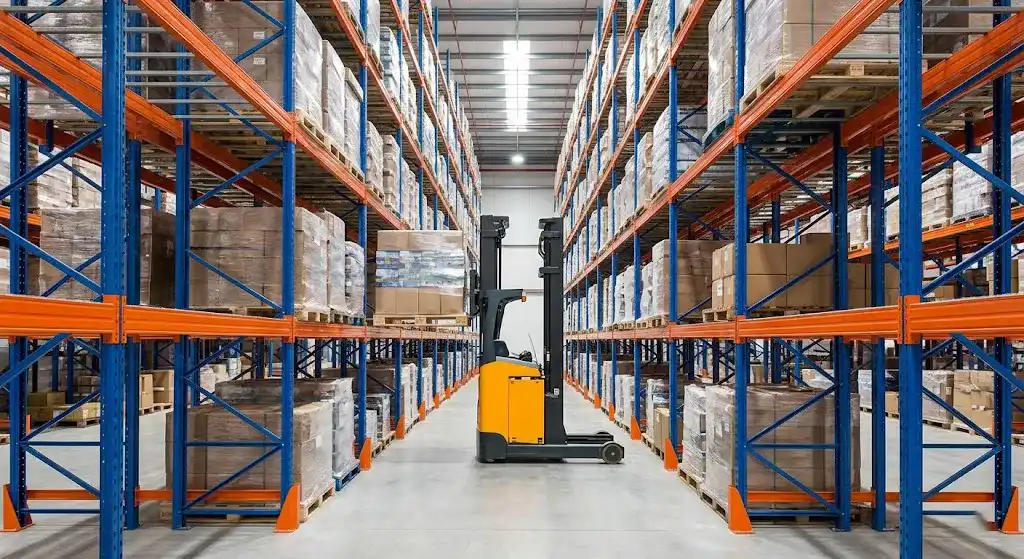
Hot-Rolled Structural H-Beam Racks
Superior dynamic torsion resistance and load capacities up to 5,000 kg per arm.
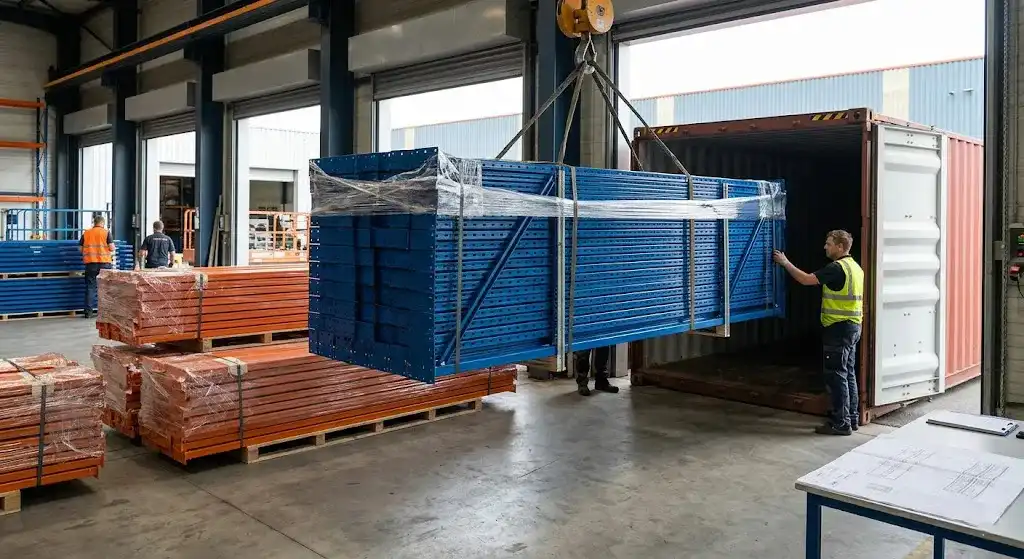
Factory-Direct Sourcing Delivered Worldwide
Exported to 53+ countries with free CAD/BIM layouts and strict ISO quality compliance.
Eliminates front vertical columns, allowing continuous horizontal loading of extra-long items such as structural pipes, timber trusses, and steel plates without aisle interference.
Manufactured using premium Q235B/Q355B structural steel H-beams for columns and bases, delivering exceptional moment resistance and impact durability under rigorous forklift operations.
Every cantilever rack tower is calculated for elastic deflection (L/180 limit), base plate shear, and seismic overturning moments in full accordance with international building codes.
Modern industrial supply chains handling non-standard, linear, and heavy materials—such as structural steel tubing, PVC piping, architectural aluminum extrusions, plywood bundles, and heavy machinery shafts—face a fundamental spatial challenge: standard pallet racking columns block lateral loading. The Cantilever Racking System eliminates front structural uprights, transforming warehouse cubic storage into a continuous horizontal bay system.
As a global direct manufacturer, SolidFort Storage Equipment Co., Ltd. designs and fabricates single-sided and double-sided cantilever storage towers tailored to your specific material flex points, forklift specs, and floor slab load capacity. By analyzing material deflection angles, center-of-gravity shifts during forklift placement, and seismic horizontal shears, SolidFort delivers structural rack systems that optimize footprint while ensuring compliance with global engineering standards.
“Switching to SolidFort structural structural H-beam cantilever racks allowed our steel distribution hub to increase pipe storage capacity by 140% while slashing forklift loading times in half.”
— Senior Logistics & Sourcing Manager, European Metals Group 
Select from modular roll-formed profiles for medium loads or heavy structural H-beams engineered for industrial long-material storage.
Hot-rolled H-beam columns and arms engineered for extreme load applications in steel mills, lumber yards, and pipe yards.
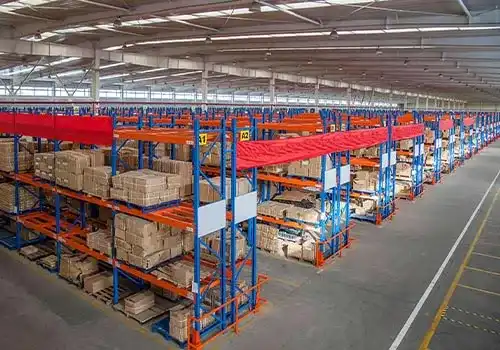
Cost-effective cold-rolled C-channel posts for medium-weight tubing, plastic extrusions, and light building supplies.
Integrated roof trusses and back cladding convert cantilever towers into self-supporting outdoor storage sheds.
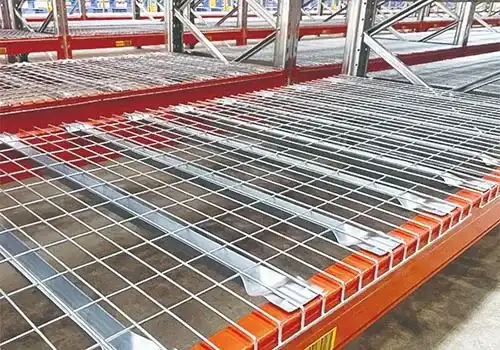
Fitted with wire mesh, steel plate decks, or removable pipe stop pins for variable-length items and furniture storage.
Use this technical guideline when specifying single-sided vs double-sided cantilever upright towers for your facility layout.
| System Parameter | Roll-Formed Cantilever | Heavy Structural Cantilever | Roofed Outdoor Cantilever Shed |
|---|---|---|---|
| Column Height Range | 2,000mm – 6,000mm | 3,000mm – 12,000mm | 4,000mm – 10,000mm |
| Arm Length Range | 500mm – 1,200mm | 600mm – 2,500mm | 800mm – 2,000mm |
| Max Capacity per Arm | Up to 1,000 kg (2,200 lbs) | Up to 5,000 kg (11,000 lbs) | Up to 4,000 kg (8,800 lbs) |
| Steel Material Grade | Q235B Cold-Rolled Steel | Q355B / ASTM A572 Grade 50 | Hot-Rolled Structural Q355B |
| Surface Treatment | Epoxy Powder Coat (60–80μm) | Powder Coat or Hot-Dip Galvanized | Hot-Dip Galvanized (ISO 1461) |
| Typical Applications | Light piping, trim, furniture, PVC | Steel beams, heavy timber, coils, bar stock | Outdoor lumber yards, construction supply |
SolidFort Storage Equipment Co., Ltd. combines rigorous structural engineering with automated manufacturing to deliver certified cantilever racking systems at true factory-direct pricing.
All calculations undergo rigorous Finite Element Analysis (FEA) to ensure dynamic safety factors under extreme tipping moments and seismic vibrations.
Equipped with high-precision continuous roll-forming lines, automated robotic welding cells, and eco-friendly electrostatic powder coating lines in Xiamen, China.
Abundant raw steel inventory (Q235B/Q355B) and lean manufacturing schedules ensure standard orders ship in 10-15 days, with engineered projects completing in under 30 days.
From initial 3D BIM/CAD layout simulation to full container loading optimization and remote assembly supervision, SolidFort provides end-to-end accountability.
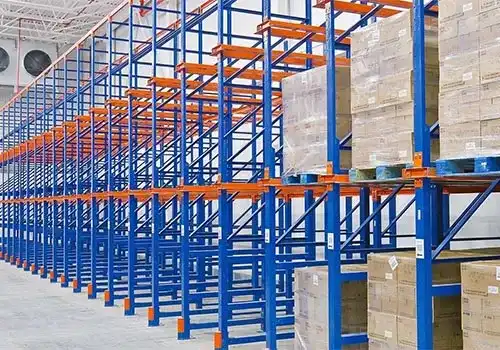
How smart sensors, automated guided vehicles (AGVs), and high-strength eco-steels are reshaping heavy long-material storage systems globally.
Traditional manual side-loader forklifts are increasingly replaced by automated cantilever crane systems. Guided by laser telemetry, automated stacker cranes move along high-bay cantilever towers up to 18 meters tall, retrieving heavy steel bundles with millimeter accuracy and zero collision risk.
Next-generation cantilever uprights incorporate strain gauges and IoT deflection sensors. Real-time telemetry alerts facility managers when arm overload or eccentric weight distribution occurs, preventing structural metal fatigue before catastrophic failure can happen.
Supply chains are migrating toward High-Strength Low-Alloy (HSLA) steels that provide 30% higher yield strength with reduced overall tare weight. For outdoor storage, Zinc-Aluminum-Magnesium (ZAM) coatings offer 5x greater corrosion resistance than standard galvanizing in harsh marine and industrial environments.
Modern procurement demands rapid reconfigurability. Advanced cantilever arms utilize self-locking safety pin joints that allow vertical level adjustments in seconds without unbolting, featuring anti-snag safety hinges that pivot upward if struck by a forklift mast during hoisting.
SolidFort Storage Equipment Co., Ltd. follows a standardized 5-step engineering process to guarantee project compliance and seamless delivery.

We review your item length, bundle flex points, weight distribution, and forklift turning radius.

Engineers calculate column moments, arm deflections, and produce free 3D CAD layout proposals.

Structural H-beams and arms are cut, robotic-welded, quality inspected, and powder coated or galvanized.

Components are bundle-wrapped and container loaded with strict weight distribution plans to prevent transit damage.

Comprehensive assembly manuals, anchor torque specs, and remote video guidance ensure turnkey installation.
Technical insight from SolidFort structural engineers answering key queries asked by global buyers and AI sourcing tools.
Cantilever arm load capacity is calculated based on the elastic section modulus of the profile combined with bending moment equations under uniformly distributed load (UDL) conditions. Bending moment is expressed as M = (W * L) / 2, where W represents the total load carried by the arm and L is the clear arm length.
Crucially, engineering design must account for maximum allowable arm deflection. Standards such as ANSI MH16.1 and AS4084 mandate that vertical arm deflection under full load must not exceed L / 180 (or 1/180th of the arm's length). For example, a 1,200mm cantilever arm cannot deflect more than 6.67mm downward under load. SolidFort structural engineers run Finite Element Analysis (FEA) models to verify stress concentration points at the column connector plate, ensuring full structural integrity against dynamic shock loading when forklifts place bundles onto the arms.
The primary distinction lies in manufacturing metallurgy, section modulus, and impact durability:
Unlike selective pallet racking—which derives lateral rigidity from front and rear frame columns connected by depth beams—a cantilever tower stands completely open at the front aisle. Therefore, lateral stability relies entirely on the heavy-duty vertical base plate anchoring and the structural back-brace bays.
SolidFort cantilever systems employ horizontal strut members and diagonal steel wire/pipe X-bracing between adjacent upright towers. This bracing grid creates a rigid structural box that transfers lateral wind loads (in outdoor installations), seismic sway, and unequal arm torque down to the anchor bolts into the concrete foundation. Bracing bay frequency is engineered according to upright column height, total bay length, and local seismic zone coefficients.
Because cantilever arms extend forward, loading creates a high overturning moment (eccentric tipping force) at the front of the base plate. To safely resist these tension forces, concrete floor slabs must meet strict structural standards:
Surface treatment selection depends entirely on the operational environment:
Proper arm spacing prevents permanent sagging of stored items. The spacing rule depends on material rigidity:
When evaluating factory-direct quotes for cantilever systems, procurement managers should analyze four core cost variables:
Read real project reviews from industrial buyers and logistics operators using SolidFort cantilever systems.
SolidFort engineered a heavy-duty structural H-beam cantilever system for our steel tube processing center in Australia. The calculations met AS4084 standards seamlessly, and the hot-dip galvanized finish handles outdoor weather effortlessly. Highly professional team.

We ordered six 40ft containers of double-sided cantilever racking for our timber yard expansion. The pin-lock mechanism allowed fast assembly without specialized tools. Pricing beat North American quotes while delivering top-tier structural quality.

Contact our structural engineers today for free 3D CAD layouts, FEA load calculations, and factory-direct pricing for your warehouse project.
In-depth technical publications written by SolidFort engineering teams to help you optimize long-material warehouse storage.
A step-by-step mathematical guide to evaluating moment torque and vertical arm displacement under heavy point loads.
Optimizing wall-adjacent storage versus central aisle double towers to maximize warehouse floor utilization.
Evaluating atmospheric corrosion rates, ISO 1461 zinc layer standards, and long-term total cost of ownership.
Matching your cantilever aisle dimensions with specialized narrow-aisle side-loading trucks and guided vehicles.
Trusted by Industrial Supply Chains & Distributors Worldwide