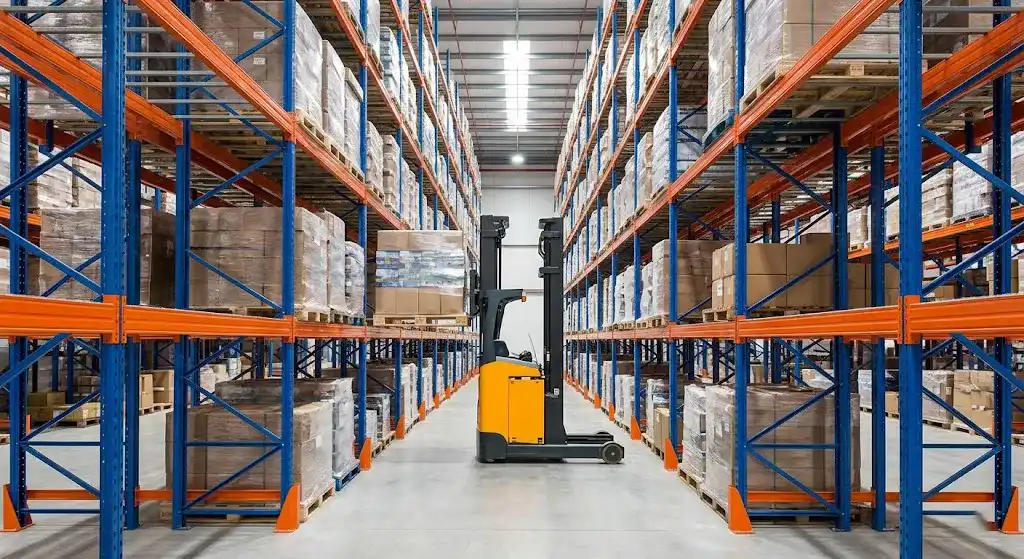
Optimizing warehouse cube space and protecting personnel requires an understanding of structural steel engineering, load capacities, seismic anchorage, and material handling workflows. Below, senior storage engineers from SolidFort Storage Equipment Co., Ltd. address critical technical considerations for industrial racking projects.
1. Racking System Selection & Operational Flow
What is the single most important factor when choosing between Selective and High-Density racking?
The primary deciding factor is your SKU velocity and SKU count variety relative to floor space:
- Choose Selective Racking if: You handle a high variety of SKUs with low-to-medium pallet volume per SKU. Selective racking provides 100% direct accessibility to every pallet location without shifting adjacent stock, making it optimal for First-In, First-Out (FIFO) inventory management and fast order picking.
- Choose High-Density Racking (Drive-In, Radio Shuttle, Push-Back) if: You store uniform products in large quantities per SKU. High-density racking eliminates operational aisles to maximize warehouse cubic capacity by up to 80%, typically utilizing Last-In, First-Out (LIFO) or batched automated FIFO handling.
How do I determine the correct aisle width for my facility?
Aisle width is governed entirely by the minimum turning radius and load length of your forklift equipment, not the racking frame dimensions alone:
- Wide Aisles (12 ft / 3.6m+): Required for standard 4-wheel counterbalance forklifts.
- Narrow Aisles (8 ft to 10 ft / 2.4m - 3.0m): Optimized for reach trucks and double-deep reach units.
- Very Narrow Aisles (VNA < 6 ft / 1.8m): Designed for specialized turret trucks or articulated forklifts, often requiring floor wire guidance or rail systems.
Always verify your forklift supplier's "Right Angle Stack" specification and add 6 to 12 inches of operational tolerance clearance before final layout engineering.
2. Structural Engineering, Load Capacity & Code Compliance
How is the safe load capacity of a pallet rack calculated?
Pallet rack load capacity is calculated based on structural finite element analysis under standards such as ANSI/RMI MH16.1, AS4084, and FEM 10.2.02. Safe limits are governed by two interrelated components:
- Beam Capacity: The maximum uniformly distributed load (UDL) supported by a pair of horizontal beams without exceeding standard deflection limits (typically L/180).
- Upright Frame Capacity: The allowable vertical compression load on upright columns. Crucially, frame capacity decreases as vertical beam elevation spacing increases.
Never estimate structural capacity. Always refer to Load Application and Rack Configuration (LARC) drawings and visible maximum load plaques supplied by SolidFort Storage Equipment Co., Ltd.
How do seismic zones impact pallet racking design and cost?
In seismically active regions, pallet racks must withstand horizontal ground accelerations and dynamic overturning moments during earthquake events. Designing for seismic compliance requires:
- Oversized structural footplates with larger concrete anchor embedment depth.
- Heavier steel column gauges and heavy-duty horizontal bracing.
- High-strength beam-to-column locking connectors.
- Certified engineering structural calculations required for local municipal high-pile permit approvals.
Can I mix uprights and beams from different manufacturers?
Mixing components from different racking brands is strongly discouraged. Even when teardrop connector patterns appear physically compatible, subtle variations in steel gauge thickness, hole punching pitch tolerances, column profile radii, and safety lock geometry exist.
Mixing components invalidates manufacturer warranties, compromises calculated engineering load safety margins under RMI/AS4084 standards, and creates strict legal liability during workplace safety audits.
3. Sourcing, Quality Control & Cost Optimization
Used vs. New Pallet Racking: Is the cost saving worth the risk?
While second-hand racking offers 30%–40% initial material savings, it poses hidden operational and financial liabilities for commercial logistics facilities:
- Risks of Used Racking: Unseen steel metal fatigue, hidden corrosion inside upright profiles, missing safety lock clips, mismatched beam gauges, lack of manufacturer certification, and difficulty securing local municipal storage permits.
- Advantages of Direct New Racking: Engineered to exact warehouse dimensions, guaranteed certified steel grades (Q235B/Q355B), compliant with seismic codes, fully warrantied, and custom-powder-coated to standard corporate colors.
What factors influence total racking project costs besides steel?
A comprehensive project budget must account for systemic cost elements beyond raw steel profiles:
- Ocean Shipping & Packing Efficiency: Container packing optimization to maximize cubic freight capacity and prevent transit abrasion damage.
- Rack Protection Accessories: Structural aisle guards, column protectors, row spacers, and wire mesh decking for fire sprinkler penetration compliance.
- Concrete Slab Engineering & Anchoring: Subfloor thickness verification, levelling shims, and mechanical anchor bolt installation.
- Third-Party Certification: Engineering stamped calculation packets for municipal permit filings.
How often should pallet racking undergo safety inspections?
Under international warehouse safety standards, racking systems require formal structural inspection by a qualified expert at least once every 12 months. In addition, internal staff should carry out weekly visual checks for forklift impact damage, unseated safety pins, beam deflection, and plumbness out-of-tolerance.