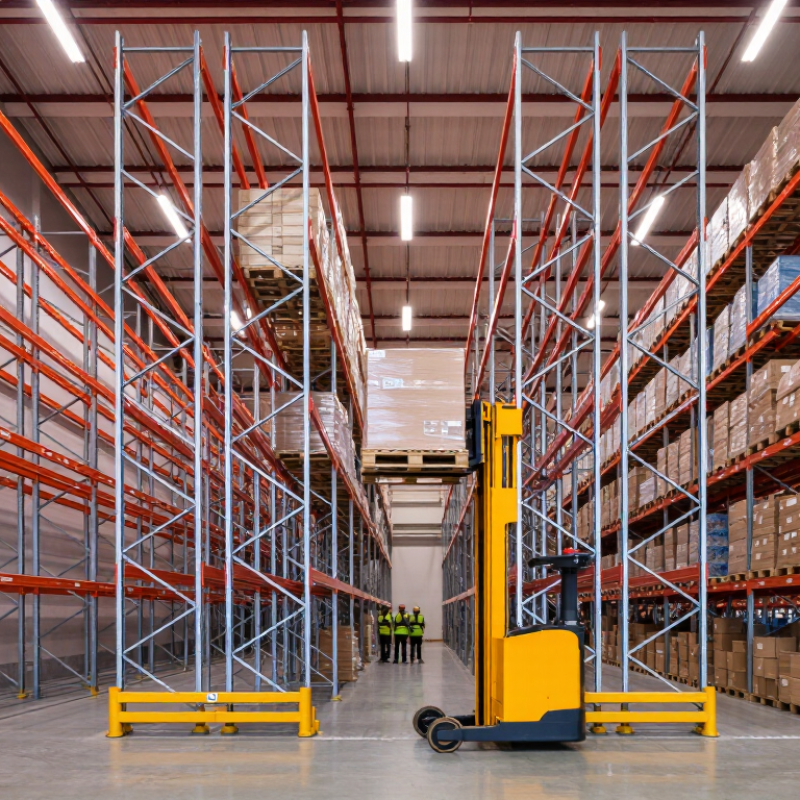
Adjustable Pallet Rack is a flexible storage system designed for warehouses that handle changing pallet sizes, products, and inventory levels. Its structure usually includes upright frames, horizontal beams, locking pins, and protective accessories. Beam heights can be changed to create different storage levels. This simple adjustment makes the system practical for many distribution centers, retail warehouses, and manufacturing facilities.
Picture a forklift placing a loaded pallet onto steel beams three meters above the floor. Each level must provide enough clearance for safe placement and removal. Operators typically access pallets from the aisle, allowing direct access to individual storage positions. This is one reason selective rack remains widely used. However, “adjustable” does not mean unlimited. Every beam, frame, connector, and floor anchor must match the manufacturer’s load data.
Details matter.
A reliable design begins with accurate measurements, pallet dimensions, product weights, forklift turning space, and building conditions. Experienced warehouse planners also consider aisle width, rack protection, seismic risk, and future expansion. Regular inspections can reveal bent uprights, missing locking devices, or damaged beams before a small defect becomes a serious hazard. Local safety requirements and qualified engineering advice should guide installation and modifications.
It is not a perfect answer for every warehouse. High-density systems may store more pallets, while adjustable rack often provides better product access. That trade-off deserves careful review. This guide explains how Adjustable Pallet Rack works, how its components support loads, and which practical factors influence a safe, efficient layout.
What Is Adjustable Pallet Rack and How Does It Work?
Adjustable pallet rack is a steel storage system with movable horizontal beams. Its main structure includes upright frames, beam connectors, braces, anchors, and pallet supports. Workers can reposition the beams to suit different pallet heights. This creates clearer storage levels without rebuilding the entire rack.
The system’s purpose is direct access to individual pallet loads. It suits warehouses handling many product types, changing inventory volumes, or frequent picking activity. A typical selective configuration places racks in parallel rows, with aisles wide enough for forklifts. Back-to-back rows improve floor use. Narrow-aisle layouts save more space but require suitable handling equipment and tighter operating control.
Several details affect performance. Beam spacing must match the pallet height, load weight, and lifting clearance. Wire decking can support pallets that do not sit safely across beams. Load signs should show the permitted capacity at each level. In real warehouse work, a rack may look stable while carrying an uneven load, which is a serious weakness. Regular inspections should check bent uprights, loose anchors, damaged beams, and missing safety pins. Drive-in, push-back, and pallet-flow configurations offer higher density, but they reduce direct access or require more careful loading discipline. A practical design balances capacity, accessibility, and safe movement rather than chasing maximum storage density.
Adjustable pallet rack uses upright frames and repositionable horizontal beams to create flexible storage levels. The chart compares representative pallet positions in depth for common rack configurations.
Typical configuration examples: actual capacity and dimensions depend on pallet size, beam capacity, load weight, aisle width, building height, and local safety requirements.
What Is Adjustable Pallet Rack and How Does It Work?
Adjustable pallet rack uses upright frames, horizontal beams, and locking clips. Uprights carry vertical loads through steel columns and bracing. Beams connect the frames and support pallets across each storage bay. Their clips fit into punched holes along the uprights. Most systems allow beam positions to change in 2-inch vertical increments.
That small adjustment can reshape an entire storage plan. A beam may sit lower for short cartons or higher for tall pallets. Workers can also create clearer forklift access between levels. However, a 2-inch slot is not a promise of unlimited flexibility. Rated capacity depends on beam length, load weight, frame height, bracing, floor conditions, and installation quality. ANSI MH16.1 design guidance emphasizes that rack performance requires engineered components, not guesswork. OSHA’s summary of Bureau of Labor Statistics data recorded 1,008 forklift-related deaths from 2011 through 2017. The number deserves practical attention.
Tips: Measure the tallest pallet, including wrapping, before setting beam levels. Leave operating clearance above every load. Check that both clips fully engage the upright holes. Inspect bent beams, missing locks, and loose anchors regularly. A useful field habit is photographing each bay after installation. It exposes uneven beam heights quickly. The simple explanation is useful, but incomplete. Load labels should match the actual configuration, and supervisors should review changes before relocation.
What Is Adjustable Pallet Rack and How Does It Work?
How Rack Load Ratings Reach 4,000–5,000 Pounds per Beam Pair
Adjustable pallet rack uses vertical frames and horizontal beams that connect at different heights. Workers can reposition the beams to fit pallets, cartons, or long containers. Locking pins secure each connection, while anchors help stabilize the frame against movement. The system looks simple. Its capacity calculation is not.
A beam pair rated for 4,000–5,000 pounds usually carries an evenly distributed load across both beams. The rating depends on beam length, steel thickness, connection design, upright strength, and the complete rack configuration. Decking can also change how weight transfers through the structure. The weakest component controls the final rating. A heavier pallet does not automatically make the rack stronger.
In warehouse inspections, damaged uprights, missing pins, and overloaded beam levels appear more often than expected. That detail matters. Load signs should show the approved capacity for each configuration, not a general guess. Engineers or qualified rack specialists should verify unusual spans, concentrated loads, seismic conditions, and changes to the layout. Pallets should sit fully on the beams, with weight distributed evenly and clear of damaged components. Real warehouses are less tidy. A rushed forklift impact or one poorly placed pallet can create stresses that the original calculation never considered.
| Data Dimension | Typical Specification or Value | How It Affects Capacity or Operation | Important Consideration |
|---|---|---|---|
| Rack Type | Adjustable pallet rack, also called selective pallet rack | Beam elevations can be changed to accommodate different pallet and product heights. | The system is normally accessed from an aisle by a forklift or other material-handling equipment. |
| Typical Beam-Pair Rating | Approximately 4,000–5,000 lb per beam pair for many medium-duty configurations | Allows two beams at one storage level to support a combined uniformly distributed pallet load within the stated rating. | This is a representative range, not a universal rating. The exact capacity must come from the rack design, engineering data, and posted load plaque. |
| Load per Beam Pair | 4,000–5,000 lb total distributed across two beams | A nominal 4,000 lb rating is about 2,000 lb per beam when the load is evenly shared; a 5,000 lb rating is about 2,500 lb per beam. | Do not treat the rating as the allowable weight for one beam or one concentrated point load. |
| Common Bay Width | Approximately 8–12 ft between upright frames | Longer beams generally experience greater bending demand and may require a heavier beam section or a lower rating. | The actual clear span, beam profile, steel thickness, and connection design determine the allowable capacity. |
| Common Upright Height | Approximately 8–24 ft in many warehouse layouts | Greater height increases the importance of frame bracing, anchorage, stability, and proper installation. | A taller frame is not automatically stronger; height-to-depth ratio and seismic or wind requirements may control the design. |
| Typical Beam Elevation Adjustment | Commonly adjusted in increments of about 2–4 in | Permits efficient vertical use of the rack and helps provide clearance above stored loads. | Both beams in a pair must be installed at the same elevation and secured with the required locking hardware. |
| Beam-to-Upright Connection | Bolted, teardrop, or other mechanically locked connection | Transfers vertical and horizontal forces from the beam into the upright frame. | Every connector must be fully engaged, and safety clips or pins must be installed as specified. |
| Load Distribution | Uniformly distributed load across the approved pallet positions | Even distribution reduces localized bending and allows the rack to perform according to its published rating. | Point loads, off-center pallets, damaged pallets, or unsupported pallet boards can reduce safe capacity. |
| Pallet Position | Pallets should be centered and fully supported by both beams | Proper positioning ensures the load is transferred consistently to the beam pair. | Required beam spacing and pallet overhang depend on the pallet type and the rack design. |
| Vertical Clearance | Often at least 3 in above the load and below the beam or obstruction | Provides operating clearance for forklift placement and helps prevent contact with upper beams. | Clearance requirements vary with the load, handling equipment, building conditions, and applicable regulations. |
| Rack Depth | Commonly about 36–48 in for standard pallet storage | Depth affects pallet support, aisle layout, frame stability, and the usable storage footprint. | The frame depth should match the pallet dimensions and required front and rear support. |
| Floor Anchorage | Typically anchored to a concrete floor with appropriate mechanical anchors | Helps resist impact, sway, sliding, and overturning forces. | Anchor type, quantity, embedment, and concrete condition must be checked for the specific installation. |
| Capacity Rating Basis | Beam strength, upright-frame strength, connections, bracing, and stability | The weakest relevant component or governing design condition limits the overall rack capacity. | A higher beam rating does not increase the allowable capacity of a weaker frame, connection, floor, or anchor system. |
| Load Plaque or Sign | Should state the maximum permitted load for the installed configuration | Provides operators with a visible reference for safe loading at each rack level or bay. | If the plaque is missing, unreadable, or inconsistent with the installation, the rack should be reviewed before loading. |
| Inspection Frequency | Routine visual checks plus documented periodic inspections | Early detection of bent frames, damaged beams, missing pins, loose anchors, or overloaded levels reduces risk. | Damaged components should be unloaded, isolated, and repaired or replaced according to a qualified assessment. |
Note: All capacity values are representative industry ranges for adjustable pallet-rack configurations. Actual allowable loads must be verified from the engineering specifications, installation details, applicable safety standards, and the posted rack load rating.
Adjustable pallet rack uses vertical steel frames and horizontal beams that support pallets at selected heights. Workers can reposition the beams as inventory sizes change. Its real value appears in the aisle, where every forklift movement must fit the engineered clearance.
A qualified rack designer calculates aisle width from the forklift’s turning radius, pallet depth, load overhang, and mast movement. Floor markings show the intended travel path. The operator enters slowly, keeps the load low, and aligns the forks with the pallet openings. Small errors matter.
The forklift raises the pallet only after its forks are fully engaged. It then moves squarely toward the rack, without scraping nearby uprights. The operator places the pallet on both beams and confirms stable contact before reversing. During retrieval, the forks slide beneath the pallet, lift it clear of the beams, and exit along the same controlled path.
It sounds simple.
In practice, clearance changes when loads bend, pallets vary, or floors become uneven. Even experienced operators can misjudge a corner by a few centimeters. Regular inspections should check damaged frames, displaced beams, missing locking pins, and overloaded levels. Rack capacity signs must match the actual configuration. A layout that works for one forklift may not suit another, especially when mast height or turning behavior differs. That detail is sometimes overlooked.
Adjustable pallet rack uses vertical frames, horizontal beams, and adjustable connectors. Operators change beam levels to fit different pallet heights. The system improves storage density, but flexibility does not remove risk.
OSHA 1910.176 requires stable storage, safe clearances, and protection from falling or collapsing materials. Its wording is practical: stored goods must not create hazards for workers.
ANSI MH16.1 provides engineering guidance for rack design, capacity, components, and installation. Load plaques should match the actual configuration, not an old layout.
According to the U.S. Bureau of Labor Statistics, the 2023 Census of Fatal Occupational Injuries recorded 1,053 fatal injuries among transportation and material-moving occupations.
That figure covers many activities, not racks alone. Still, it shows why traffic control and inspection deserve attention. A slightly bent upright may look harmless. It may not be.
Tips: Inspect frames, beams, anchors, connectors, and protection devices at planned intervals. Record each defect with its location and date. Remove damaged sections from service when stability is uncertain. Never exceed posted capacity.
ANSI guidance supports qualified review, while OSHA expects hazards to be corrected promptly. A monthly checklist helps, but it cannot replace a competent person’s judgment after an impact. The imperfect part is often human: rushed loading, missing labels, or an unreported forklift strike.
It uses vertical frames, horizontal beams, and adjustable connectors. Workers change beam heights for different pallet sizes. Locking pins secure each connection. Anchors help limit movement.
It usually means both beams support an evenly distributed load. The rating depends on beam length, steel thickness, connections, and upright strength. It does not mean one point can safely carry that weight. Not automatically.
The weakest component controls the complete rating. A strong beam cannot compensate for a damaged upright or weak connection. Decking may also change how weight transfers. Check the entire configuration.
Pallets should sit fully on both beams. Keep the load balanced across the available support. Avoid damaged beams, bent frames, and unstable pallets. One misplaced pallet can create unexpected stress.
Beam levels, spans, decking, and components may change over time. An old sign can show the wrong capacity. Signs should identify the approved configuration clearly. Record changes before loading.
Inspect frames, beams, anchors, connectors, locking pins, and protection devices. Look for bends, missing parts, impact marks, and loose connections. Record each defect with its location and date. Record it.
Stop using the affected section when stability is uncertain. Mark or isolate the area clearly. A qualified person should assess the damage before reuse. A quick glance may miss hidden weakness.
No. A checklist supports regular monitoring, but it cannot replace a competent review after an impact. Workers may overlook small bends or missing labels. Human judgment sometimes fails. That matters.
Keep stored goods stable, maintain safe clearances, and never exceed posted capacity. Control forklift traffic around rack aisles. Report impacts immediately. Rushed loading creates avoidable risk.
Adjustable Pallet Rack is a flexible storage system designed to organize palletized goods while making efficient use of warehouse height and floor space. Its main components include upright frames, horizontal beams, and locking clips that secure each level. Because the beams can be repositioned in approximately 2-inch vertical increments, storage locations can be adapted to different pallet sizes, product heights, and handling needs. Common configurations may include single-row, double-row, and back-to-back layouts, depending on warehouse capacity and aisle planning.
A properly engineered system can support roughly 4,000–5,000 pounds per beam pair, although the actual rating depends on design, materials, load distribution, and installation. Forklifts place and retrieve pallets within specified aisle clearances to reduce collision risks and maintain operational efficiency. Safe use also requires following OSHA 1910.176 and ANSI MH16.1 guidance, including keeping aisles clear, respecting posted load limits, checking structural components, and inspecting the rack regularly for damage or instability.