Choosing a supplier for Double Deep Pallet Racking is not just a price comparison. It changes how many pallet positions fit in a warehouse and how easily operators reach them. MHI’s 2024 Annual Industry Report found that 55% of surveyed supply-chain leaders planned to increase investment in technology and innovation. That wider push makes practical storage decisions more important, not less. Still, a broad industry survey cannot tell you whether one rack design suits your building.
Double-deep systems place pallets two positions deep, increasing storage density while reducing direct access to each pallet. That trade-off matters when selecting a Chinese supplier. Ask for layout drawings, load calculations, steel specifications, and clear guidance on compatible reach trucks. Check how the supplier accounts for pallet dimensions, floor conditions, and local seismic requirements. Request evidence of production quality, installation support, and comparable warehouse projects. Small details count: a beam rating, upright thickness, or aisle width can affect safe daily operation.
Look beyond polished catalogues. Compare response times, documentation, spare-parts availability, and the supplier’s ability to explain design choices in plain language. Ask questions. A low quotation may omit important items, while a long export history alone does not prove a suitable design. The strongest shortlist should combine verified technical information with honest discussion of access, capacity, and operating limits. This guide examines suppliers through that practical lens.
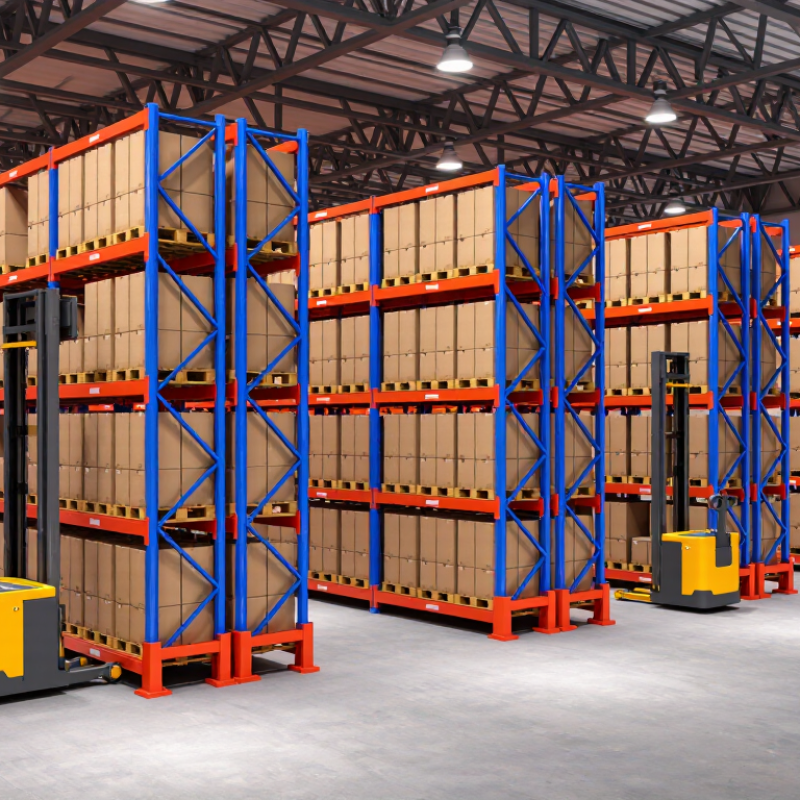
Double deep pallet racking stores two pallets behind one another in each storage lane. From the aisle, a forklift can reach the front pallet directly. A specially equipped double-reach truck extends its forks to place or retrieve the pallet behind it. This arrangement can increase storage density by using fewer aisles than standard selective racking. It does not make every pallet equally accessible.
The front pallet blocks the rear one. In practice, staff generally need to move the front load before reaching the back position.
That is the trade-off.
The system works best when several pallets share the same product and stock rotation can accommodate this access pattern. Before installation, measure pallet depth, load weight, and any overhang. Check the truck’s reach and aisle requirements against the actual warehouse layout, not just a drawing.
Small details matter. A pallet that sits unevenly can reduce clearance between loads. Rack beams, frames, floor conditions, and protective guards also need to suit the intended loads and equipment. Clear load signs help operators avoid exceeding rated capacity. Double deep racks may not suit fast-moving products that require every pallet to be picked independently. I would review real picking patterns before choosing them; storage density looks attractive on paper, but extra handling can complicate daily work.
When comparing Chinese suppliers, assess engineering, manufacturing control, and after-sales support—not price alone. Double deep layouts need compatible reach trucks, accurate beam levels, and clear load limits. Ask for project-specific drawings, load calculations, steel test documents, and installation instructions. Check whether the supplier can explain how floor condition, rack height, and pallet dimensions affect the design. A polished catalog proves little. Request references for similar installations and inspect welds, coatings, and packaging procedures.
Safety deserves careful attention. The U.S. Bureau of Labor Statistics reported 4.4 recordable injury and illness cases per 100 full-time workers in 2023. This figure is not rack-specific, but it highlights the risks of busy storage operations. Ask suppliers how they specify rack protection, inspect components, and handle replacement parts. Confirm that drawings address the site’s applicable design requirements; a generic quotation may miss important local conditions. Small details matter.
Tips: Ask for a sample inspection report, production photos, and a written warranty. Compare lead times and spare-beam availability, not just the initial quote. Verify every claim against documents. A remote audit helps, but it cannot reveal everything; that limitation is worth stating openly.
China’s double deep racking suppliers generally fall into three groups: rack manufacturers, trading companies, and warehouse engineering integrators. Manufacturers produce uprights, beams, and support rails in their own facilities. Ask for steel grades, rated load data, and inspection records—not just a low quotation. A neat catalog is not proof. Request drawings that match your pallet dimensions and actual floor conditions.
Trading companies can coordinate export packing and communication, but may rely on outside factories. Confirm who handles design changes, quality checks, and replacement parts. Engineering integrators offer a broader service, often combining rack layouts with forklift and warehouse-flow planning. This matters because double deep storage needs compatible reach trucks and reduces direct access to some pallets. Check the proposed aisle width, pallet access sequence, and capacity assumptions. Ask for references from comparable installations.
Supplier categories can overlap, and a strong factory may still need a qualified local installation team. I would compare documented specifications, sample welds, coating consistency, and response times before choosing. One weakness in many proposals is limited explanation of future expansion. Ask what happens when pallet sizes change or a beam is damaged. The answer should be specific.
Small details matter.
When comparing double deep pallet racking suppliers in China, look beyond a polished quotation. Ask for steel specifications, coating details, and inspection records for welds and finished components. Request drawings that show beam levels, clearances, and the loads used in the design. A sample rack can look reassuring, but it cannot prove every production batch is consistent. Ask how defects are recorded and corrected.
Capacity means more than factory size. Double-deep storage depends on suitable handling equipment and reduces direct access to some pallets. Share your pallet dimensions, weights, aisle limits, and expected daily movements with the supplier. Check whether its engineering team can model the layout and explain the trade-offs. Ask for realistic production and shipping schedules, with the assumptions stated clearly. Delays can happen; vague promises make planning harder.
Service matters after delivery. Confirm who checks site measurements, answers installation questions, and supplies replacement parts. Ask for a named contact and a clear response process, not just a sales promise. If possible, speak with a customer using a similar layout and ask what went wrong as well as what worked. No checklist catches everything. Leave room for a second review before approving final drawings.
Supplier comparison scorecard — enter evidence-based scores for each shortlisted supplier. The criteria and weights below are an evaluation framework, not supplier-specific claims or market rankings.
| Evaluation Dimension | Weight | What to Compare and Verify | Supplier 1 Score (1–5) |
Supplier 2 Score (1–5) |
Supplier 3 Score (1–5) |
Evidence / Notes |
|---|---|---|---|---|---|---|
| Structural design and compliance | 20% | Request project-specific drawings and calculations. Check whether the supplier can demonstrate design practice aligned with applicable requirements, such as EN 15512 for adjustable steel static storage systems and EN 15620 for tolerances, deformations, and clearances. Confirm which standards and editions apply to the destination market. | — | — | — | |
| Load engineering and double-deep suitability | 15% | Compare the stated load per pallet position and beam level against your actual pallet weight, dimensions, rack height, bay configuration, and floor conditions. Verify that the design accounts for the double-deep arrangement, the specified reach truck or handling equipment, and required clearances. | — | — | — | |
| Manufacturing quality control | 15% | Review documented inspection procedures for incoming steel, forming or welding, coating, dimensional checks, and final inspection. Ask for recent inspection records and sample test reports. An ISO 9001 certificate can support process evaluation but does not, by itself, prove that a specific rack design is suitable. | — | — | — | |
| Production capacity and delivery planning | 10% | Assess the supplier’s confirmed capacity for your required quantities and delivery schedule using a production plan, current workload, equipment information, and milestone dates. Compare the quoted lead time, production slots, packaging plan, and contingency arrangements rather than relying on an unverified headline capacity figure. | — | — | — | |
| Material and component traceability | 8% | Check whether steel grades, material batches, key components, and finished products can be linked to inspection or purchasing records. Confirm how nonconforming parts are identified, corrected, and documented. | — | — | — | |
| Installation and project engineering | 10% | Compare layout support, site measurement, installation instructions, installer qualifications, supervision options, and handover documentation. Confirm responsibility for floor-level checks, anchoring details, rack protection, and final inspection. | — | — | — | |
| After-sales service and safety support | 10% | Review the written warranty terms, spare-parts availability, technical support channels, damage-reporting process, and response commitments. Ask how the supplier supports rack inspections and maintenance; EN 15635 covers the use and maintenance of storage equipment where applicable. | — | — | — | |
| Documentation and project handover | 7% | Confirm delivery of approved drawings, load notices, installation and inspection records, operating guidance, and a parts list. Check that documentation matches the final installed configuration and is available in the required language. | — | — | — | |
| Customization and commercial clarity | 5% | Compare the supplier’s ability to accommodate pallet sizes, aisle layout, building constraints, finish requirements, and handling equipment. Check quotation scope, exclusions, payment milestones, packing, shipping terms, and change-order procedures. | — | — | — | |
| Weighted total | 100% | Calculate each supplier’s total as: sum of (criterion weight × score ÷ 5). Use only scores supported by documents, inspections, or verifiable references. | — / 100 | — / 100 | — / 100 |
| Score | Scoring Guide |
|---|---|
| 1 — Weak | Little or no supporting evidence; major requirements remain unclear. |
| 2 — Limited | Partial evidence provided, with notable gaps or conditions requiring follow-up. |
| 3 — Meets requirements | Documented evidence addresses the stated project requirements. |
| 4 — Strong | Complete, consistent evidence and clear project-specific controls are provided. |
| 5 — Verified strong | Evidence is complete and independently checked through a suitable audit, test, inspection, or reference. |
Important: There is no universal load rating or production-capacity figure that applies to every double-deep pallet rack. Confirm structural capacity through project-specific engineering calculations and verify all technical, certification, delivery, and service claims before placing an order.
Before comparing quotes, send each supplier the same bay dimensions, pallet weights, beam levels, and forklift details. Ask for project-specific drawings and signed load calculations, not a generic capacity chart. For double-deep layouts, verify capacity against paired pallet positions, beam spans, upright frames, and the reach truck’s operating envelope. Small mismatches matter. Request material specifications, coating details, weld inspection records, and traceable steel certificates. Compare these with the delivered components. Have a qualified rack engineer review the calculations against applicable design standards and site conditions.
Check the factory, not only its website. Review production records, quality-control steps, packaging, spare-part availability, and references for similar installations. A video call can show welding stations, but it cannot prove consistency across shifts; ask for dated inspection evidence or arrange an independent audit. MHI’s 2024 Annual Industry Report found that 55% of surveyed supply-chain leaders planned to increase investment in supply-chain innovation over the following two years. This signals growing attention to operational capability, not proof that any rack supplier is reliable. Start with an inspected sample or small order. Confirm hole alignment and connector engagement on site, then document defects before full shipment. It takes time. I still find quote comparisons awkward when delivery scope is vague, so define installation, freight, warranty response, and replacement-part lead times in writing.
Use this suggested scorecard to compare suppliers. Verify each item with supporting documents, samples, or an on-site assessment; the percentages are recommended evaluation weights, not supplier survey results.
Prioritize structural calculations and load-test evidence, then confirm the system suits your double-deep layout and handling equipment. Check applicable safety documentation, spare-parts support, and references before making a decision.
It stores two pallets behind each other in one lane. A double-reach truck accesses the rear pallet. The front pallet must move first.
It can store more pallets by using fewer aisles. That is the trade-off. Some pallets are less accessible.
It suits locations storing several pallets of the same product. Stock rotation must allow rear pallets to wait. Fast, independent picking may be awkward.
Check pallet depth, load weight, and any overhang. Confirm truck reach and aisle width against the real floor plan. Drawings can miss things.
A double-reach forklift extends its forks to reach rear positions. Confirm its reach, turning needs, and aisle requirements before approving the layout.
Manufacturers make rack components. Trading companies may use outside factories, while engineering integrators can plan racks and warehouse flow. Ask who handles design changes and quality checks.
Request steel specifications, rated-load data, weld inspection records, and coating details. Ask for drawings matched to your pallets and floor conditions. A glossy catalog proves little.
Share pallet sizes, weights, aisle limits, and daily movements. Ask how the design handles those loads. Capacity assumptions should be written down.
Identify who checks site measurements, supports installation, and supplies replacement parts. Ask for a named contact and response process. I would review final drawings twice; one review can miss a beam clearance issue.
This article explains what Double Deep Pallet Racking is and how it works. By storing pallets two positions deep on each side of an aisle, this system can increase storage density while still allowing access to a wider range of goods than some high-density alternatives. Its layout, equipment requirements, load capacity, and suitability for different inventory and warehouse conditions should all be considered before selecting a solution.
The guide also outlines how to evaluate Chinese suppliers, from manufacturers and system integrators to trading companies. It covers practical ways to compare product quality, production capacity, customization options, communication, installation support, and after-sales service. Buyers can follow a clear verification process: define warehouse needs, request technical details and quotations, assess supplier capabilities, check references or inspection options, and confirm specifications before placing an order. These steps help businesses make an informed choice based on operational fit, reliability, and long-term value.