Warehouse space is costly, and unused air above a floor can represent missed capacity. Drive-In Pallet Racking addresses this by storing pallets several positions deep in guided lanes. A forklift enters each lane to place or retrieve loads. The arrangement can increase storage density, especially when a facility holds many pallets of the same product.
The wider industry context matters. MHI’s 2024 Annual Industry Report found that 55% of surveyed supply-chain professionals planned to increase technology investment. That figure does not measure demand for drive-in racks specifically. It does, however, reflect sustained attention to warehouse efficiency and capacity. In practice, the right system depends on more than floor space: pallet dimensions, forklift clearances, load weights, and daily picking patterns all shape the design.
There is a trade-off. Drive-in systems commonly use last-in, first-out (LIFO) access, so they suit uniform products with predictable rotation better than mixed, fast-moving stock. A driver must enter the rack lane carefully, and damaged uprights can be difficult to spot. Small details matter. Rack capacity should be confirmed from the manufacturer’s specifications and a qualified design review, not guessed from appearance. Fire protection and building constraints also need professional assessment. More density is not automatically better. This guide explains how the system works, where it fits, and which practical limits deserve a closer look.
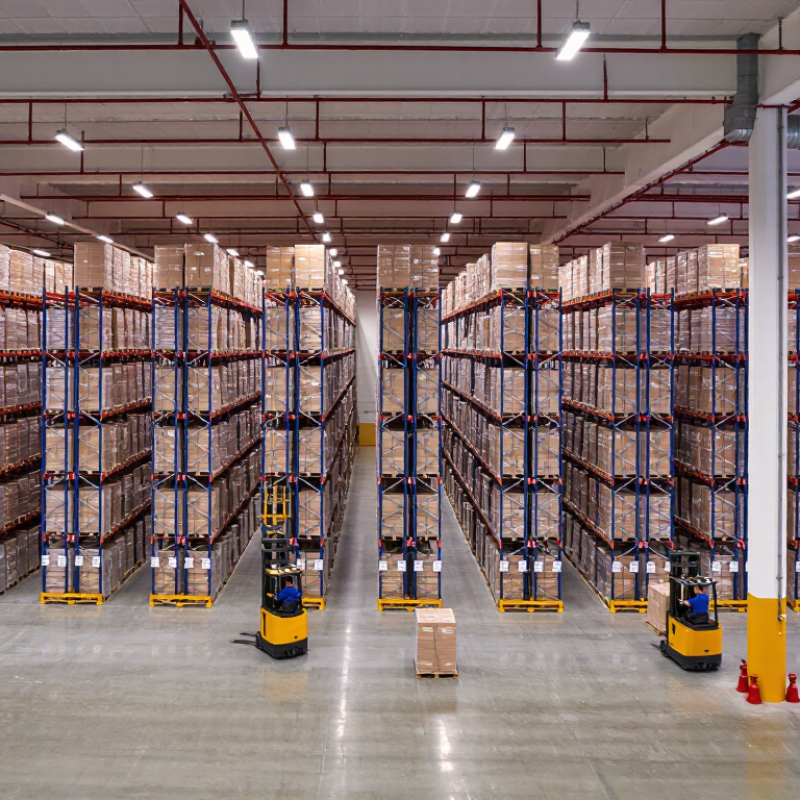
Drive-in pallet racking is a high-density storage system built around deep lanes instead of many separate aisles. Forklifts enter each lane to place or retrieve pallets, which rest on rails fixed along the rack frames. The arrangement uses floor space efficiently, but access to individual pallets is limited. In a typical drive-in layout, the last pallet loaded is the first one retrieved: a last-in, first-out flow.
A practical example is a cold room storing many pallets of the same product. Fewer aisles can mean more room for storage, while the forklift must travel carefully between the support rails and uprights. Not every SKU fits. This system works best when products are uniform and pallet turnover follows a predictable order. Drive-through racking differs because forklifts can enter from both ends, allowing a first-in, first-out flow when operations are set up for it.
MHI’s 2024 Annual Industry Report found that 55% of surveyed supply-chain professionals planned to adopt robotics and automation within five years. That figure describes broader technology investment, not drive-in rack performance. It does, however, highlight why layout decisions deserve close attention: equipment, handling methods, and storage design must work together. High density sounds efficient, but congestion or poor product rotation can undermine the benefit.
In drive-in racking, a forklift enters a storage lane to place or retrieve pallets. Pallets are stored several positions deep, making better use of floor space than layouts with a separate access aisle for every rack row. Drive-in lanes are typically accessed from one side and often operate on a last-in, first-out (LIFO) basis.
Illustrative layout: The chart assumes one pallet position at each depth slot. Actual capacity depends on the rack design, pallet dimensions, clearances, and warehouse layout.
Drive-in pallet racking forms deep storage lanes from upright frames, side rails, and overhead bracing. The rails support pallets at each level, leaving a central path for a forklift. Instead of placing pallets on individual front-facing beams, the operator carries each load into the lane and sets it onto the rails. The lane is the key. Several pallets can sit one behind another, using floor space efficiently while reducing the number of access aisles.
This layout works best when many pallets hold the same product. A forklift usually enters from the front, stores newer loads deeper, and retrieves the nearest load first. That creates last-in, first-out handling. A small clearance error can cause trouble: pallets may scrape the frames, or a load may sit unevenly on its rails. For that reason, lane width, pallet dimensions, forklift turning space, and load weight need careful checking before installation. Operators also need clear visibility and training when driving beneath the structure. Deep lanes look neat on a plan, but real pallets are not always perfectly square. Regular checks for bent rails, loose connections, and frame damage help catch problems early.
| Feature | Structure or arrangement | How it works | Operational effect |
|---|---|---|---|
| Storage lanes | Each lane holds pallets several positions deep, with pallet-support rails running along the lane. | A forklift enters the lane and places pallets on the rails, building storage depth inward from the aisle. | More floor area can be used for pallet storage because fewer access aisles are needed between individual pallet positions. |
| Upright frames and rails | Upright frames form the sides of the lanes; horizontal rails support pallet loads at designated levels. | The forklift raises or lowers a pallet to the required level, then positions it on the supporting rails. | Lane width, height, rail levels, and capacity must be designed for the pallets, loads, and handling equipment in use. |
| Forklift access | The forklift travels into the open face of the rack lane rather than placing every pallet from a separate aisle. | The operator drives carefully into the lane to load or retrieve a pallet, following the rack layout and operating rules. | The rack and aisle arrangement must provide suitable clearance for the forklift and its load. |
| Loading sequence | In a typical drive-in arrangement, a lane is accessed from one end. | Pallets are generally loaded from the back of the lane toward the entrance, filling deeper positions before the front positions. | Product grouping and the planned retrieval sequence are important because access to deeper pallets depends on the positions in front. |
| Retrieval sequence | The same lane entrance is used for loading and retrieval. | In a typical drive-in lane, the front pallet is retrieved first; pallets behind it become accessible as the lane is cleared. | This arrangement generally follows last-in, first-out (LIFO) rotation, so it is best suited to inventory that does not require strict first-in, first-out rotation. |
| Drive-in vs. drive-through | Drive-in rack has access from one end; drive-through rack can be accessed from both ends. | A drive-through lane can be loaded at one end and unloaded at the other when the layout and operating process support that flow. | Two-ended access can support first-in, first-out (FIFO) handling, while one-ended drive-in access typically supports LIFO handling. |
| Suitable inventory | Deep lanes work best when multiple pallets in a lane contain the same product or are managed as a compatible group. | Operators can work through one lane at a time without needing direct access to every pallet from a separate aisle. | High-density storage may come with reduced selectivity: a specific pallet can be harder to reach when other pallets occupy the same lane. |
| Pallet and load requirements | Pallets must fit the lane and be suitable for support on the rack rails; loads should be stable and within the system’s rated capacity. | Consistent pallet dimensions and sound pallet condition help the forklift place loads correctly on the rails. | Before operation, confirm pallet compatibility, load limits, and any system-specific restrictions with the rack design information. |
| Safety and inspection | Rack components, lane clearances, and load-supporting rails form part of the storage system. | Operators should follow site procedures, avoid striking the structure, and report visible damage or displaced components. | Damaged rack components or unsafe loading can affect system performance; inspections and repairs should follow applicable site procedures and qualified guidance. |
In a drive-in pallet rack, a forklift enters the storage lane to place or retrieve a pallet. The pallet rests on side rails, not on a conventional crossbeam. Operators usually load from the back of the lane toward the entrance, keeping each pallet square and centered. Keep the lane clear. The forklift must travel slowly and stay aligned, since a fork or mast can strike a rail or upright.
Retrieval follows the reverse order: the last pallet loaded is normally the first removed. That makes drive-in storage a last-in, first-out system, suited to batches with few product changes. Small gaps matter. Poorly positioned pallets can obstruct access or leave neighboring loads unstable. Operators should follow posted rack capacities and check rails and uprights for visible damage; a quick glance may miss a bent component.
OSHA safety materials cite U.S. estimates of roughly 85 forklift-related deaths and 34,900 serious injuries each year. This is a broad forklift-risk estimate, not a drive-in-rack incident rate, but it underlines why controlled speed and trained operators matter. One practical weakness is the temptation to move faster when a lane is nearly empty. That is when drivers may misjudge the remaining clearance. Operators should pause, confirm the route, and remove pallets without contacting the rack.
Drive-in pallet racking is most suitable when a warehouse stores large quantities of a small number of products. A food distributor holding several pallets of the same canned item, for example, can use deep lanes to reduce the floor space taken by aisles. It can also suit seasonal stock, provided pallets within each lane are expected to move in last-in, first-out order. The newest pallet is usually the first one retrieved. That matters.
The system works best with consistent pallet dimensions and stable, undamaged loads. Forklift operators drive into the rack lanes, so clear sightlines, careful speed control, and well-trained staff are important in daily use. High-density storage can be valuable in chilled rooms, where every aisle uses space that may need cooling.
Still, density is not automatically efficiency. If a site handles many product types or needs strict first-in, first-out rotation, deep lanes may slow retrieval and complicate stock checks. A layout that looks excellent on a drawing may feel awkward during a busy shift. Test lane depth and handling patterns against real order volumes before committing.
Drive-in pallet racking stores pallets on rails inside deep storage lanes. A forklift enters each lane to place or retrieve loads, so the system needs fewer access aisles than many selective rack layouts.
Less aisle space.
Its high storage density can suit facilities handling large quantities of a few products, such as identical cartons or seasonal stock. Loading and retrieval usually take place from the same end, which commonly means last-in, first-out access. This works when older stock does not need to leave first. The gains can be real, though a layout that looks efficient on paper may feel less flexible during a busy shift.
Limited selectivity is a key trade-off: reaching a pallet near the back may require moving the loads in front of it. Mixed product sizes can also make lane planning awkward. Forklift drivers must enter lanes carefully and align pallets with the support rails; small errors can damage rack components or loads. Pallets should be consistent in size and condition, and operators should follow posted load limits and report impacts. It is easy to underestimate how much training the layout needs.
It is a high-density storage system with deep lanes instead of many separate aisles. Forklifts enter the lanes to place or retrieve pallets.
Side rails support each pallet along the lane. Pallets do not rest on individual front-facing crossbeams.
The newest pallet is usually placed deepest in the lane. The nearest pallet is removed first. Simple, but limiting.
It works best for large batches of similar products with predictable turnover. Frequent product changes can make retrieval awkward.
Forklifts typically enter drive-in lanes from one end, creating last-in, first-out handling. Drive-through lanes allow access from both ends and can support first-in, first-out handling.
Check pallet dimensions, lane width, load weight, and forklift turning space. Real pallets are not always perfectly square.
Drive slowly and keep the forklift aligned between the rails and uprights. A small clearance error can scrape a frame.
Look for bent rails, loose connections, and damaged frames. A quick glance can miss a problem, so checks need care.
Drive-In Pallet Racking is a high-density storage system that uses deep lanes to make efficient use of warehouse space. Its framework supports pallets on rails running along each lane, while the open aisle at the front allows a forklift to enter the rack structure. By storing pallets several positions deep, the system reduces the number of aisles needed compared with conventional selective racking.
During operation, a forklift drives into a lane to place or retrieve pallets, following the lane’s loading sequence. Because access is generally from one end, pallets are usually handled on a last-in, first-out basis. This makes Drive-In Pallet Racking most suitable for large quantities of similar products with relatively low turnover. Its main benefits are high storage density and efficient use of floor space; limitations include reduced selectivity, careful forklift operation requirements, and the potential for slower access to specific pallets.