Featured Industrial Racking Systems
Factory-direct high-density storage solutions optimized for cold storage, logistics centers, and bulk inventory management.
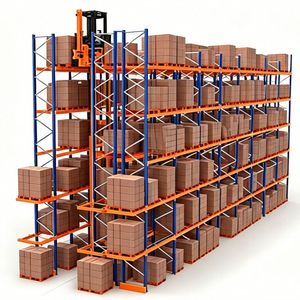
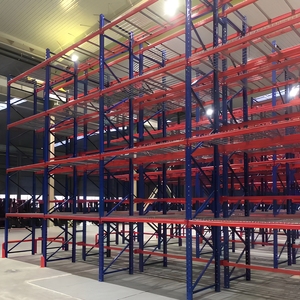
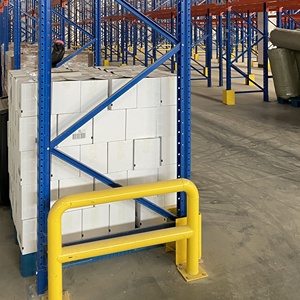
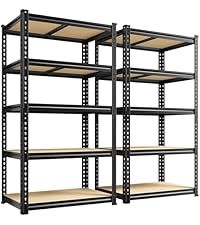
Architectural Engineering of CE Certified Drive-Through Racking Systems
As modern distribution centers and cold storage facilities face surging land costs and tightening operational margins, Drive-Through Pallet Racking has emerged as the premier structural system for high-density cubic storage. Unlike traditional selective pallet racking—which requires operating aisles between every rack row—drive-through racking enables forklifts to drive directly into the storage bays from either side of the block, utilizing a true First-In, First-Out (FIFO) inventory sequence.
From a mechanical engineering standpoint, drive-through systems eliminate cross-aisle ties on the floor and intermediate horizontal beams, relying instead on continuous cantilevered pallet rails welded or bolted to vertical upright frames. This layout demands rigorous load distribution calculations, material specification control (such as high-tensile Q235B and Q355B cold-rolled steel), and strict structural certifications.
Mechanical Design Comparison: Drive-In vs. Drive-Through Racking
While often grouped together, Drive-In Racking and Drive-Through Racking possess distinct structural dynamics and operational behaviors:
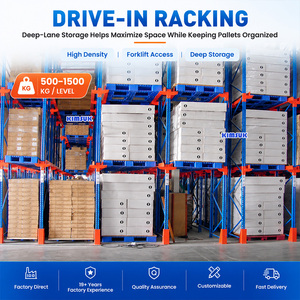
- Drive-In Systems (LIFO): Closed at one end by rear bracing or wall boundaries. Forklifts enter and exit through the same front aisle, making the last pallet stored the first pallet retrieved (Last-In, First-Out). Structural stability is reinforced by full-height X-bracing along the rear frame back walls.
- Drive-Through Systems (FIFO): Completely open on both opposing ends. Forklifts drive entirely through the rack corridor. Because rear bracing cannot be placed across the entry corridor, structural rigidity relies on heavy-duty overhead top-bracing beams, portal frames, and heavy anchor baseplates bolted directly into concrete slabs.
| Racking Technology | Inventory Flow | Space Efficiency | Access Selectivity | Forklift Compatibility | Structural Rigidity Method |
|---|---|---|---|---|---|
| Drive-Through Racking | FIFO (First-In, First-Out) | 80% – 85% | Low (Per Lane Basis) | Reach Truck / Counterbalance | Top-Portal Bracing & Floor Rails |
| Drive-In Racking | LIFO (Last-In, First-Out) | 75% – 80% | Low (Per Bay Basis) | Standard Counterbalance | Rear Diagonal Frame X-Bracing |
| Selective Pallet Rack | FIFO / LIFO (Flexible) | 35% – 40% | 100% Direct Access | All Forklift Types | Horizontal Beam Key Connection |
| Radio Shuttle Racking | Automated FIFO / LIFO | 85% – 90% | Medium (Automated) | Standard Forklift + Automated Shuttle | Tie Beams & Interlock Frame |
SolidFort Industrial Co., Ltd.: Manufacturing Powerhouse & Export Expertise
Founded in 2016 and headquartered in Tongan District, Xiamen, China, SolidFort Storage Equipment Co., Ltd. operates a state-of-the-art 30,000 square meter production complex dedicated to structural steel fabrication and warehouse rack engineering. Operating as a direct factory manufacturer rather than a trading intermediary, SolidFort controls the complete production lifecycle—from raw coil slitting to automated cold roll-forming, robotic welding, electrostatic powder coating, and international container packaging.
SolidFort Quality Assurance Core Principles (E-E-A-T Guarantee)
Every batch of drive-through racking frames and cantilever rails undergoes strict structural testing. Our steel yield strengths are validated against Q235B (yield strength ≥235 MPa) and Q355B (yield strength ≥355 MPa) grade standards. Frame columns feature continuous omega-profile punch patterns engineered to distribute vertical point loads while minimizing torsional buckling during accidental forklift impacts.
Strategic Sourcing & Future Trends in Drive-Through Pallet Storage (2026–2030)
As logistics infrastructure undergoes digital transformation, global procurement managers and warehouse architects must account for upcoming technological shifts when specifying structural rack systems. The next decade of high-density warehouse storage is being reshaped by five critical macro trends:
1. Integration of Autonomous Forklifts (AGVs) and AMRs
Traditional drive-through racking systems require human drivers to maneuver forklifts inside narrow storage tunnels—a practice that carries inherent risk of upright impact. Next-generation systems feature integrated magnetic floor guidance, laser-guided reflection targets, and widened entrance funnel rails designed specifically for Automated Guided Vehicles (AGVs) and Autonomous Mobile Robots (AMRs). Buying drive-through systems with AGV-compatible tolerances today prevents costly retrofit upgrades tomorrow.
2. Structural Health Monitoring via IoT Sensors
With predictive maintenance becoming standard across Industry 4.0 operations, high-bay drive-through structures are increasingly integrated with strain-gauge sensors and IoT acceleration sensors. These embedded sensors monitor column deflection, seismic stress, and accidental forklift impacts in real-time, instantly notifying safety supervisors before micro-fractures compromise structural stability.
3. Growth of Cold-Chain Logistics and Energy-Efficient Cubic Design
Global demand for temperature-controlled storage (pharmaceuticals, frozen foods, biologics) continues to outpace standard ambient warehousing. Because refrigeration energy costs scale by total room volume rather than floor area, drive-through and drive-in racking represent the primary structural mechanism to maximize pallet density per cubic meter of refrigerated air, slashing per-pallet operational energy costs by up to 35%.
4. Eco-Friendly Galvanized & Low-Carbon Steel Sourcing
Environmental, Social, and Governance (ESG) mandates are pushing B2B buyers to evaluate the carbon footprint of structural steel storage equipment. Suppliers utilizing recycled structural steel, low-VOC powder coatings, and hot-dip galvanizing process optimizations are earning preferred vendor status across North American and European supply chains.
Frequently Asked Procurement Questions (B2B Buyer FAQ)
Technical answers from SolidFort's structural engineering team to assist your procurement decisions.
Ready to Maximize Your Warehouse Storage Capacity?
Contact SolidFort's structural design team today for a free CAD warehouse floor layout, structural load calculation report, and factory-direct price quotation.
Get Catalog