Engineered Deep Lane Storage Racking Systems
High-bearing industrial warehouse rack components direct from our ISO 9001-certified 30,000㎡ manufacturing facility in Xiamen, China.
Engineering Deep Lane Storage Systems: A Strategic Engineering Whitepaper for B2B Supply Chain Logistics
As industrial floor space acquisition costs accelerate globally and urban logistics hubs demand hyper-optimized volumetric density, warehouse operations directors are forced to re-evaluate traditional wide-aisle pallet racking topologies. Sourcing high-density Lane Storage Racking Systems from qualified Chinese OEM/ODM suppliers has emerged as the premier capital-efficient strategy for 3PL providers, cold storage operators, and heavy manufacturing logistics centers.
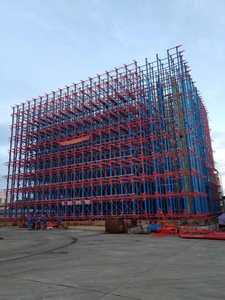
A deep lane racking infrastructure—encompassing Drive-In/Drive-Thru, Very Narrow Aisle (VNA), Radio Shuttle cart systems, and Automated Storage and Retrieval Systems (AS/RS)—fundamentally eliminates empty forklift travel aisles in favor of continuous storage channels. Choosing the optimal lane storage geometry involves calculating pallet turnover velocity, structural slab load-bearing capacities, deflection limits under dynamic seismic conditions, and total cost of ownership (TCO).
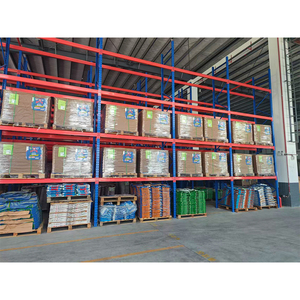
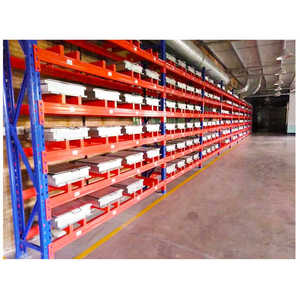
Drive-In & Drive-Thru Racking
Maximizes volumetric capacity by up to 85% by allowing forklifts to drive directly into storage lanes along continuous cantilevered support rails. Designed for high-volume, low-SKU inventory operates predominantly under Last-In, First-Out (LIFO) or First-In, First-Out (FIFO) logic.
Semi-Automated Radio Shuttle
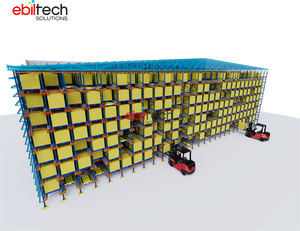
Integrates autonomous self-powered shuttle carts inside deep storage channels (up to 40+ pallets deep). Eliminates forklift lane entry, drastically reducing frame collision risks, boosting pallet transfer cycles by 400%, and functioning seamlessly in cold storage down to -30°C.
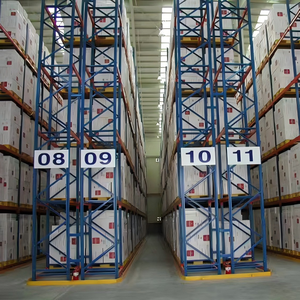
Very Narrow Aisle (VNA) Systems
Condenses operating aisle widths down to 1.5–1.8 meters while extending vertical heights up to 15 meters. Provides 100% immediate selectivity to every individual SKU alongside a 40–50% storage footprint compression when combined with wire-guided turret trucks.
Technological Evolution & Procurement Trends in Deep Lane Storage (2025–2030)
The enterprise procurement landscape for industrial racking systems is undergoing a monumental shift driven by automation, material metallurgy advances, and stringent environmental compliance standardizations. Key macro trends impacting global procurement directors include:
- AGV/AMR Autonomous Integration: Modern deep lane systems are increasingly engineered with precision-guided entry points designed specifically for Autonomous Mobile Robots (AMRs) and Automated Guided Forklifts (AGVs). Tolerances for beam level deflections are now tightened from standard L/200 down to L/300 to ensure optical sensors on robotic vehicles achieve flawless pallet placement.
- High-Strength Micro-Alloy Steels: Leading China racking manufacturers like SolidFort have transitioned from standard carbon steels to cold-rolled, high-yield Q355B structural grade steel. This provides higher tensile strength with lighter frame weights, lowering shipping weight while sustaining ultimate point loads exceeding 4,500 kg per beam level.
- Cold Chain Energy Footprint Compression: Cold storage facilities absorb significant electrical power per cubic meter. Implementing 30-pallet-deep Radio Shuttle systems cuts refrigerated room square footage requirements by half, directly reducing thermal envelope loss and operational utility expenditures.
- IoT Structural Health Monitoring: Next-generation rack columns feature integrated piezo-electric strain sensors and wireless telemetry nodes that instantly alert safety personnel if a forklift collision compromises an upright frame's structural elasticity.
Engineering Comparison: High-Density Racking Topologies
To assist warehouse engineers in evaluating system trade-offs, the following matrix outlines operational parameters across primary deep-lane and high-density racking configurations:
| Racking Topology | Selectivity | Volumetric Density | Access Logic | Forklift Risk | Ideal Application |
|---|---|---|---|---|---|
| Selective Pallet Racking | 100% | Standard (40%) | FIFO / LIFO | Very Low | High SKU diversity, retail logistics |
| Very Narrow Aisle (VNA) | 100% | High (65%) | FIFO / LIFO | Low (Guided) | High-density picking, archive storage |
| Drive-In Racking | Low (15-20%) | Very High (85%) | LIFO | Moderate / High | Bulk homogeneous goods, seasonal inventory |
| Radio Shuttle Racking | Moderate (30-40%) | Maximum (90%) | FIFO or LIFO | Extremely Low | Cold storage, FMCG, high-volume manufacturing |
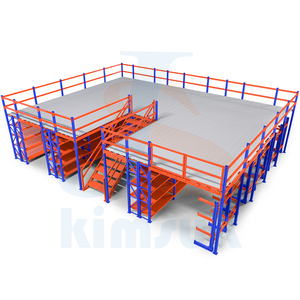
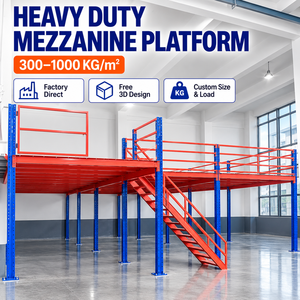
| Rack-Supported Mezzanine | 100% (Manual) | High (200% Floor Gain) | Custom Flow | Low | Parts distribution, combined picking/storage |
Structural Safety Compliance Notice: RMI MH16.1 & AS4084 Standard
Purchasing rack structures from international suppliers requires verified structural compliance. SolidFort designs every rack upright profile, beam connector, and floor anchor footplate to strictly meet or exceed the American RMI (ANSI MH16.1), Australian AS4084-2012, and European FEM 10.2.02 codes. Comprehensive Load Application and Rack Configuration (LARC) drawings and engineering calculation packets are supplied with every OEM shipment.
SolidFort Enterprise Strengths: Why Partner With Our Factory
SolidFort Storage Equipment Co., Ltd. is a specialized manufacturer and exporter of heavy-duty industrial storage equipment operating out of a modern 30,000 square meter plant in Tongan Park, Xiamen, China. Built upon a decade of structural engineering expertise, we support distributors, logistics contractors, and facility managers across 53+ nations.
Full Structural Certification
ISO 9001 certified manufacturing with mill test certificates (MTC) provided for every batch of Q235B/Q355B cold-rolled steel. CE documentation available for European market entry.
Engineered CAD & Simulation
Free fast-turnaround 2D layout drawings, 3D BIM spatial models, slab point-load calculations, and custom rack component prototyping prior to mass production.
10–15 Day Fast Delivery
High-capacity automatic roll-forming production lines and continuous automated powder coating ensure standard production runs ship within 10 to 15 days on FOB, CIF, or DDP terms.
Comprehensive Protection Accessories
Extensive accessory range including heavy-duty column protectors, frame end guards, wire mesh decking, pallet support bars, and seismic base anchor plates.
Procurement & Engineering FAQs
Detailed technical responses regarding load calculations, installation compliance, slab requirements, and logistics.
Pricing for industrial racking depends on overall steel tonnage, dynamic load specifications, surface finish, and system complexity. Standard selective pallet racking generally averages between USD 50 and USD 100 per pallet position. High-density systems such as Drive-In racking or Push-Back systems range from USD 100 to USD 180 per position. Automated Radio Shuttle systems and deep lane shuttle infrastructure typically average USD 150 to USD 250+ per pallet position (excluding shuttle cart electronics). Request a project quotation to receive precise factory-direct pricing based on current steel market indexes.
Under international standards including ANSI/RMI MH16.1 and AS4084-2012, anchoring every rack baseplate to the reinforced concrete floor slab is mandatory. Anchoring prevents horizontal displacement during pallet placement, counters uplift forces caused by high-bay loading, and maintains structural geometry in the event of minor forklift impacts or seismic activity. Anchor bolt diameter, embedment depth, and concrete compressive strength (minimum 3,000 PSI / 20 MPa) must be engineered based on the height-to-depth ratio of the upright frame.
Beam capacities are determined by calculating the Maximum Allowable Uniformly Distributed Load (UDL) sustained across a pair of beams without exceeding a vertical deflection limit of L/200 (where L is the clear span length of the beam). For instance, an 8-foot (2,438mm) beam pair carrying two 1,200 kg pallets (2,400 kg total load) must suffer no greater deflection than 12.19mm at mid-span under full load. Maximum allowable capacity also assumes safety factors of at least 1.65 against material yield strength.
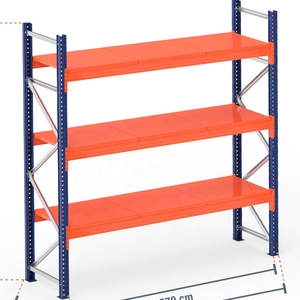
For standard 40 x 48 inch (1,016 x 1,219 mm) GMA pallets, the industry standard upright frame depth is 42 inches (1,067 mm), allowing a 3-inch (76 mm) front and back pallet overhang over the step beams. The most common beam span is 96 inches (2,438 mm) or 108 inches (2,743 mm) for holding two pallets side by side with proper safety clearances. For European Euro pallets (1,200 x 800 mm) or Asian standard pallets (1,100 x 1,100 mm), frame depths of 800 mm to 1,100 mm and custom beam lengths are precision manufactured upon request.
While both systems provide exceptional storage density, Drive-In racking requires forklifts to drive physically inside the steel rack lanes. This increases the frequency of upright frame damage, structural fatigue, and driver risk. In contrast, Radio Shuttle racking keeps forklifts safely at the front aisle face while autonomous shuttle vehicles traverse the internal lanes. This reduces rack maintenance costs by up to 75%, significantly enhances operational safety, and accelerates pallet turnover speed.
Every export project includes a detailed engineering dossier consisting of 2D/3D CAD layout drawings, Load Application and Rack Configuration (LARC) drawings, load capacity plaques for rack row ends, steel mill test certificates (MTC), assembly instruction manuals, and container loading diagrams. On-site technical supervision or step-by-step video installation guidance is available for international logistics projects.
Accelerate Your Warehouse Capacity Today
Send us your warehouse layout dimensions, pallet weight requirements, and ceiling clear height. Our senior racking engineers will design a complimentary optimized storage CAD proposal within 24 hours.