Executive Sourcing Brief: Two-Way Radio Shuttle Racking Systems
In modern logistics engineering, optimizing floor space efficiency while controlling total cost of ownership (TCO) remains the primary objective for supply chain directors, logistics consultants, and cold storage warehouse managers. The China Wholesale Two Way Shuttle Racking System represents a powerful intermediate automation architecture that bridges the gap between conventional static pallet racking (such as Selective or Drive-In racking) and fully automated AS/RS (Automated Storage and Retrieval Systems).
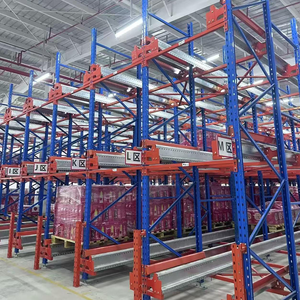
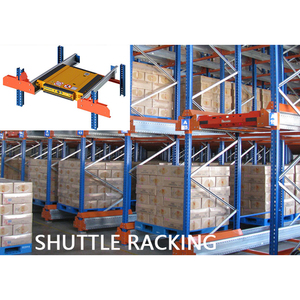
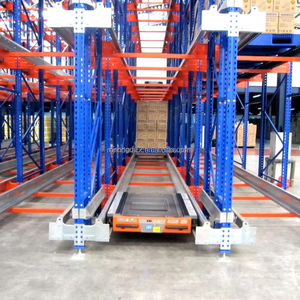
Engineered specifically for high-volume, low-SKU operations, a radio shuttle racking system utilizes self-powered pallet carts (radio shuttles) operating inside specialized storage channels on dedicated guide rails. Controlled remotely via RF transmitters or tablet interfaces, these autonomous carts lift, carry, and deposit heavy pallet loads to the furthest available storage positions within deep channels. This eliminates the necessity for forklifts to enter storage aisles, directly resolving the structural damage risks, slow cycle times, and safety hazards inherent to traditional drive-in racking configurations.
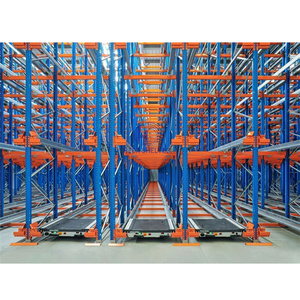
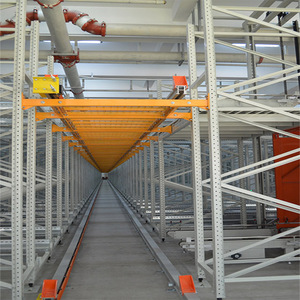
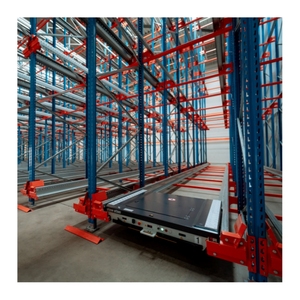
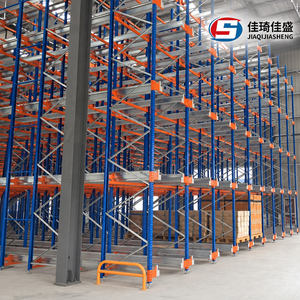
High Space Utilization Rate
Eliminate forklift aisles inside storage bays. Achieve up to 85% storage density compared to 35-40% for conventional selective racking.
Reduced Forklift Damage
Operators load and retrieve pallets strictly at the front face of the rack array. Shuttle carts do the interior travel, drastically lowering rack frame collision risks.
FIFO & LIFO Flexibility
Configure channels seamlessly for First-In-First-Out (FIFO) in double-sided access setups or First-In-Last-Out (LIFO) in single-side wall-adjacent installations.
Engineering Insights: Mechanics & Structural Architecture of 2-Way Shuttle Racking
A professional two-way radio shuttle racking system is far more than standard warehouse shelving with a mechanical car placed on top. It is a precise electro-mechanical system where structural tolerance requirements are far stricter than traditional static storage installations.
1. High-Tensile Steel Profiles & Rail Geometry
The upright frames and horizontal beams of SolidFort two-way shuttle systems are manufactured using premium Q355B (equivalent to S355JR / ASTM A572 Grade 50) cold-rolled steel. The load-bearing shuttle rails feature a continuous, cold-formed profile designed specifically to handle both the concentrated wheel point-loads of loaded shuttle carts (up to 2,000 kg operational weight) and horizontal dynamic vibration during rapid acceleration and deceleration.
To ensure structural compliance under international engineering codes—including **ANSI/RMI MH16.1**, **AS4084-2012**, and **FEM 10.2.02**—every racking structure undergoes Finite Element Analysis (FEA) testing. Deflection limits are constrained strictly below $L/200$ for horizontal beams and $H/500$ for vertical frame members under maximum combined load conditions.
2. Power Management & Lithium ($LiFePO_4$) Battery Reliability
Modern wholesale China radio shuttle carts feature advanced Lithium Iron Phosphate ($LiFePO_4$) battery packs equipped with intelligent Battery Management Systems (BMS). Compared to legacy lead-acid or nickel-cadmium batteries, $LiFePO_4$ technology yields significant operational advantages:
- Extended Duty Cycles: 8 to 10 hours of continuous operation on a single 3-hour fast charge.
- Cold Chain Resilience: Specialized battery heating jackets allow full power output in deep-freeze environments as low as -30°C without rapid voltage drop.
- High Thermal Stability: Inherently safe chemical composition minimizing thermal runaway hazards in automated logistics centers.
3. Dual Operational Logistics Modes: LIFO vs. FIFO
The adaptability of two-way shuttle systems allows enterprise procurement managers to tailor storage lanes to match exact inventory turn profiles:
- LIFO (Last-In, First-Out): Ideal for drive-in replacement. Forklifts deposit and pick pallets from a single front aisle. The shuttle transports pallets into the lane during loading and pushes them back to the front face during retrieval.
- FIFO (First-In, First-Out): Requires loading from the rear aisle and unloading from the front aisle. Essential for perishable food products, pharmaceuticals, and date-sensitive retail goods requiring batch control.
Engineering Comparison: Two-Way Shuttle vs. Alternative High-Density Systems
| Storage System Type | Storage Density | Selective Access | Forklift Damage Risk | Labor Cost / Throughput | Relative Capital Investment |
|---|---|---|---|---|---|
| Selective Pallet Racking | Low (~35-40%) | 100% Direct | Moderate | High Labor / Slow | Low Baseline |
| Drive-In Racking | High (~65-75%) | Low (Per Lane) | Very High | High Risk / Slow | Low-Medium |
| Two-Way Radio Shuttle Rack | Very High (up to 85%) | Medium (Lane Level) | Extremely Low | Low Labor / Rapid | Optimal ROI Balance |
| Full AS/RS (Stacker Crane) | Maximum (~90%+) | 100% Automated | None | Fully Automated | Very High CAPEX |
Future Sourcing & Procurement Trends for Global Buyers
As global supply chains navigate labor shortages, rising industrial real estate costs, and sustainability mandates, purchasing managers sourcing from OEM China shuttle rack factories must anticipate key market evolutions:
1. Shift toward Modular Hybrid Automation
Enterprise buyers are moving away from monolithic, rigid automation toward modular setups. Two-way shuttle racking serves as the ideal foundational phase. Warehouses can deploy standard 2-way radio shuttles today, and later integrate vertical lifters or upgrade channels for 4-way shuttle compatibility as throughput requirements scale—all without replacing the core racking superstructure.
2. WMS & IoT Sensor Protocol Convergence
Modern radio shuttles are no longer standalone islands of automation controlled purely by handheld RF remotes. Leading Chinese suppliers now integrate standard **Modbus**, **CANopen**, or **Wi-Fi 802.11ac** communication chips directly into the shuttle controller. This allows direct API integration into Warehouse Management Systems (WMS) and ERP platforms (such as SAP, Oracle, or Manhattan Associates), enabling real-time telemetry, battery health monitoring, automated inventory auditing, and predictive maintenance alerts.
3. Carbon Neutrality & Energy Efficient Warehousing
In cold-chain warehouse environments (where refrigeration accounts for up to 60% of total electrical energy costs), reducing cubic volume that needs cooling is vital. Two-way shuttle systems reduce warehouse building volume requirements by 40% for the same pallet capacity. Furthermore, shuttle carts equipped with regenerative braking capture kinetic energy during deceleration, reducing net power consumption per pallet transfer cycle.
Factory Strength & Manufacturing Rigor: Why Partner with SolidFort
As a factory-direct pallet racking manufacturer operating a 30,000㎡ modern production facility in Tongan District, Xiamen, China, SolidFort Storage Equipment Co., Ltd. provides global buyers with structural reliability, custom engineering flexibility, and direct pricing advantages.
- In-House Manufacturing Control: Complete cold-roll forming, robotic welding, automated laser punching, and electrostatic powder coating production lines ensure strict dimensional tolerance.
- Comprehensive Quality Compliance: Systems designed, tested, and manufactured in alignment with AS4084-2012 (Australia), RMI ANSI MH16.1 (USA), and FEM 10.2.02 (Europe) standards.
- Turnkey Engineering Support: Free CAD warehouse layout planning, structural load calculation reports (LARC drawings), dynamic simulation, and export container optimization included with every project inquiry.
- Rapid Export Dispatch: Standard orders completed and loaded within 10 to 15 days, backed by export experience to over 53 countries worldwide.
Optimize Your Warehouse Footprint Today
Connect with our senior engineering team for a customized CAD warehouse layout design, structural load calculation, and factory-direct quotation within 24 hours.
Contact Us