Featured Heavy-Duty Double Row & Double Deep Systems
Engineered for high-volume distribution centers, cold storage, and manufacturing plants requiring optimal floor space utilization and high structural integrity.
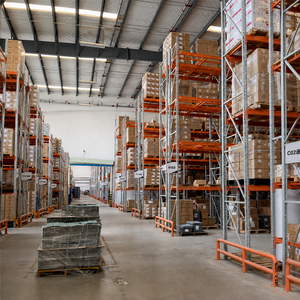
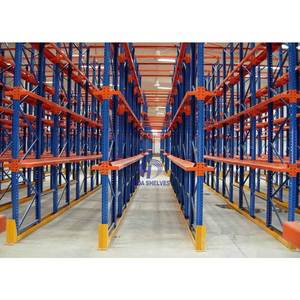
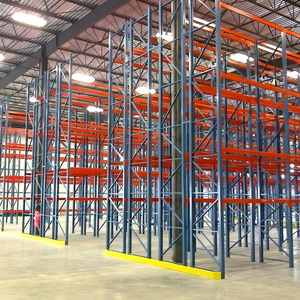
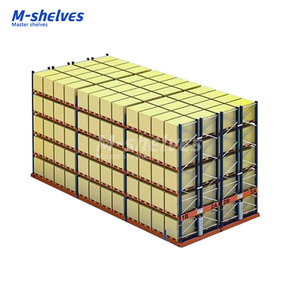
Structural Mechanics and Architectural Optimization of Double Row Racking
In contemporary warehousing infrastructure, the selection of heavy-duty storage configurations directly dictates operational throughput, floor space efficiency, and long-term capital efficiency. As a recognized Custom OEM Double Row Pallet Racking Factory & Exporter, our engineering design principles prioritize structural stability, load-bearing integrity, and seismic mitigation while maximizing storage density per square meter.
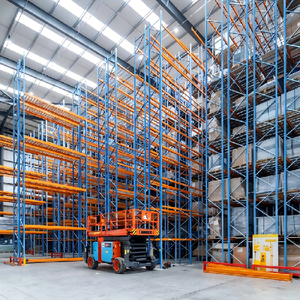
Double Row Pallet Racking—often configured as back-to-back single-deep rows or integrated into double-deep pantographs—eliminates redundant operating aisles. By placing two single rack rows back-to-back connected by structural row spacers, facilities gain immediate structural cross-bracing benefits. This back-to-back layout increases the effective slenderness ratio stability of the upright frames along the transverse axis, allowing for higher vertical elevation without compromising load parameters under ANSI MH16.1 or AS4084-2023 standards.
Aisle Optimization Math
Standard selective racking consumes up to 60% of warehouse floor area in operating aisles. Double row systems connected with specialized pantograph reach trucks reduce aisle count by 40-50%, boosting pallet capacity by 30% to 40% in identical building footprints.
Back-to-Back Row Spacers
Robust structural steel row spacers maintain a mandatory flue space (typically 200mm to 300mm) required by NFPA 13 fire safety codes, permitting unhindered water penetration from overhead fire suppression sprinklers.
High Tensile Q355B Steel
Manufactured exclusively from high-yield cold-rolled steel profiles (Q235B & Q355B equivalent to ASTM A1011 Grade 50), engineered to withstand dynamic impact, racking sway, and heavy point-load concentrations up to 4,500 kg per beam pair.
Global Procurement Trends & Industrial Sourcing Outlook (2025–2030)
The international industrial storage equipment sector is undergoing a massive shift driven by supply chain centralization, cold-chain expansion, and automated material handling integration. B2B procurement managers, warehouse automation integrators, and logistics directors are evolving their purchasing criteria from pure initial material cost to Total Cost of Ownership (TCO), compliance longevity, and OEM supply chain resilience.
1. Proliferation of Automated Reach Forklifts & Double-Deep Pantographs
As warehouse labor costs increase globally, operations are upgrading from standard counterbalanced trucks to deep-reach pantograph forklifts and Automated Guided Vehicles (AGVs). This technological transition directly drives demand for high-precision OEM Double Deep Pallet Racking. Beam deflection tolerances must strictly adhere to maximum L/200 (length divided by 200) to ensure automated fork sensors can insert and extract inner-row pallets smoothly without structural collision.
2. Cold-Chain & E-Commerce Fulfillment Center Density Optimization
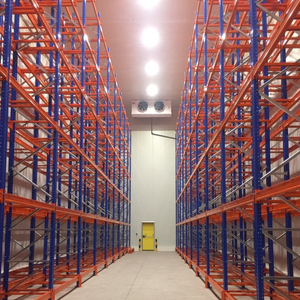
Cold storage logistics facilities bear extreme energy overheads per cubic meter of refrigerated volume. Storing cold-chain SKUs in double-row high-density configurations reduces thermal loss zones and maximizes frozen pallet positions. Simultaneously, rapid e-commerce fulfillment operations rely on double-row selective configurations outfitted with heavy-duty safety mesh decking, drop-in dividers, and column guards to prevent accidental collision damage during high-velocity picking shifts.
3. Demand for Standardized Certification & Factory Transparency
Global importers across North America, Europe, Australia, and the Middle East no longer accept uncertified structural products. Regional building codes dictate strict adherence to finite element analysis (FEA) testing. Sourcing managers require factories to present ISO9001 certifications, mill test certificates (MTC), independent load testing reports, and standardized Load Application and Rack Configuration (LARC) engineering documentation prior to contract execution.
Technological Innovations & Manufacturing Evolution
Manufacturing modern double row pallet racking systems is no longer a rudimentary fabrication process. High-volume export factories utilize automated continuous roll-forming lines, robotic welding stations, and automated electrostatic powder coating systems to guarantee sub-millimeter manufacturing precision.
| Manufacturing Stage | Legacy Sourcing Standards | SolidFort Next-Gen OEM Standard | Customer Benefit |
|---|---|---|---|
| Steel Sheet Selection | Recycled secondary strip steel | Prime Cold-Rolled Steel Coils (Q355B / Q235B) | 30% higher yield strength & zero micro-cracks under load. |
| Column Roll Forming | Manual brake press bending | Multi-stage continuous cold roll-forming lines | Sub-millimeter pitch consistency across 12+ meter uprights. |
| Connector Beam Welding | Manual shielded arc welding | Multi-axis robotic GMAW (CO2/Argon) cell welding | Uniform weld penetration, zero cold welds, maximum shear resistance. |
| Surface Protection | Basic air-dry liquid painting | 6-stage pre-treatment + Epoxy-Polyester Powder Coating | High impact, scratch, and corrosion resistance for 15+ years. |
| Pitch Versatility | Fixed 50mm or 75mm non-standard | Universal 75mm (AS) & 76.2mm / 3-inch (RMI) teardrop pitch | Seamless compatibility with international rack accessories. |
SolidFort Manufacturing Capabilities & Direct Export Strengths
SolidFort Storage Equipment Co., Ltd. is a leading factory-direct racking manufacturer operating from a modern 30,000㎡ production complex in Tongan District, Xiamen, China. Operating since 2016, SolidFort has established an international footprint, exporting custom-engineered selective racking, double-deep racking, drive-in systems, radio shuttle racks, cantilever units, and mezzanine platforms to over 53 countries worldwide.
30,000㎡ Manufacturing Hub
Equipped with 8 automated cold roll-forming lines, automated laser cutting centers, and robotic welding cells capable of producing over 3,000 metric tons of finished industrial racking monthly.
Rigorous Compliance Standards
Designed strictly under AS4084 (Australian Standard), RMI ANSI MH16.1 (USA), and FEM 10.2.02 (European Code). ISO9001 certified manufacturing guarantees structural compliance for permit approvals.
10–15 Day Rapid Lead Time
Extensive raw material steel inventories and optimized production scheduling enable rapid turnaround: standard orders ship in 10-15 days; complex engineered projects complete in approximately 30 days.
Unlike trading intermediaries, SolidFort delivers complete engineering-to-delivery support. Every client project receives free CAD layout design, detailed LARC calculation drawings, customized packaging plans for maximum container cube utilization, and complete shipping support under FOB, CIF, or door-to-door DDP terms.
Frequently Asked Questions (FAQ)
Technical and commercial guidance curated by SolidFort senior structural racking engineers.
1. Beam Pair Capacity: The maximum uniformly distributed load (UDL) a pair of horizontal beams can support without exceeding deflection limits (L/200).
2. Upright Frame Capacity: The allowable vertical compression load on the column profiles, which decreases significantly as the unbraced vertical beam spacing (level distance) increases. Always refer strictly to official manufacturer Load Application and Rack Configuration (LARC) plaques.
• Upright Frame Depth: Standard depth is 42 inches (1067mm) or 44 inches (1100mm), allowing a 3-inch (75mm) pallet overhang front and back for proper beam seating.
• Beam Length: Standard length is 96 inches (2438mm) or 108 inches (2743mm) to store two pallets per level with appropriate clearance.
• Row Spacer Length: Typically 8, 10, or 12 inches (200mm - 300mm) to satisfy flue space fire regulations.
Pallet Storage System Selection Matrix
Evaluate system trade-offs to select the optimal structural configuration for your storage facility.
| Storage System Type | SKU Selectivity | Storage Density | Forklift Compatibility | Ideal Application |
|---|---|---|---|---|
| Selective Double Row Rack | 100% Immediate Access | Moderate (40-50% Space Use) | Standard Counterbalance / Reach Truck | High SKU variety, fast-moving distribution |
| Double Deep Pallet Rack | 50% Immediate Access | High (60-65% Space Use) | Deep-Reach Pantograph Forklift | Homogeneous SKUs, batch storage, cold rooms |
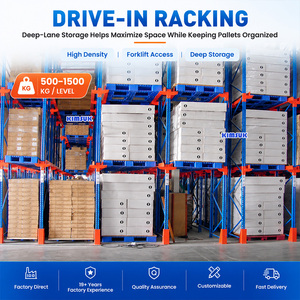
| Drive-In / Drive-Thru Rack | Low (LIFO / FIFO) | Very High (75-85% Space Use) | Standard Reach / Counterbalance | Seasonal inventory, high-volume bulk goods |
| Radio Shuttle Storage | High Batch Selectivity | Maximum (up to 90% Space Use) | Robotic Shuttle Cart + Standard Forklift | Cold storage, beverage, high-throughput logistics |
Ready to Optimize Your Warehouse Layout & Storage Capacity?
Get a complimentary 2D/3D CAD warehouse layout design, structural load analysis, and competitive factory-direct quote from SolidFort's engineering team within 24 hours.