Standard & Custom Pallet Racking Systems
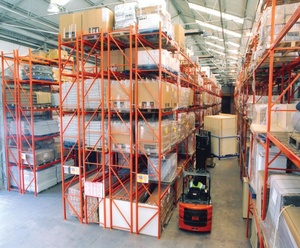
Double Deep Pallet Racking High Capacity Storage System Suitable for Reach Truck Forklift Optimize Warehouse Space Utilization
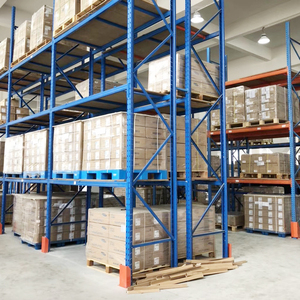
Industrial Pallet Rack Warehouse Rack Q235B Steel Heavy Duty 5 Adjustable Storage Rack Manufacturer FEM/RMI Certified Custom
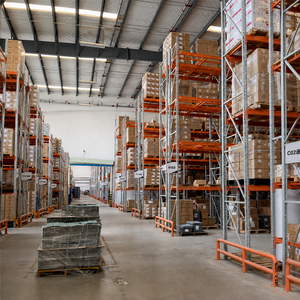
Heavy Duty Pallet Rack Back to Back Double Entry Row with Safety Guardrails for E-commerce Fulfillment Center Storage
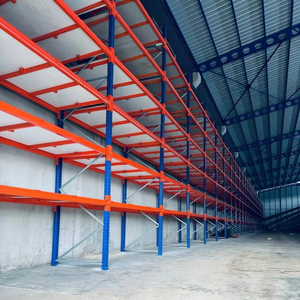
Peterack CE Certified Heavy Duty Stacking Shelf Racks Pallet Rack Multi Layer Shelf Garage Stacking Shelf Warehouse Storage Rack
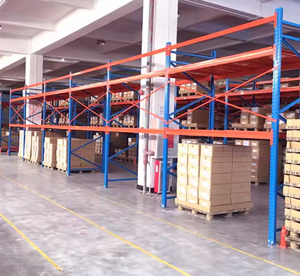
OEM Factory Wholesale Heavy-Duty Large Capacity Steel Pallet Racking System Iron Warehouse Rack Storage Shelves
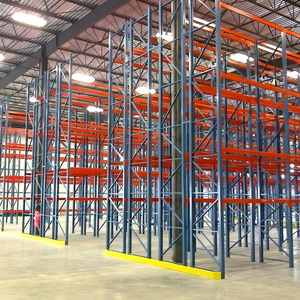
Modular Multi Level Frame Batch Pallet Inventory Double Row Storage Rack Standard Warehouse Double Deep Pallet Racking
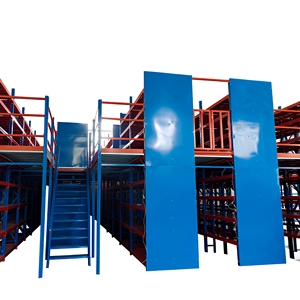
Custom Corrosion Protected Adjustable Pallet Rack Steel Structure Mezzanine Floor Heavy Duty Warehouse Loft Platform Racking
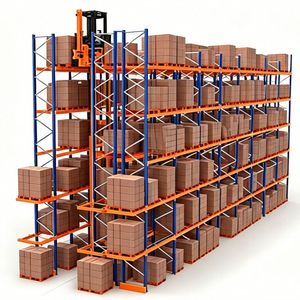
Professional Grade Heavy Duty 5-Layer Steel Powder Coated Storage Racking-Industrial Pallet System High Density Warehouse
Engineering OEM Standard Pallet Racking for Global Logistics & Supply Chains
Modern warehouse management requires storage infrastructure that maximizes cubic volume while ensuring strict structural stability under continuous load cycles. As a specialized OEM standard pallet racking manufacturer and global exporter, SolidFort Storage Equipment Co., Ltd. operates a 30,000㎡ advanced manufacturing complex in Tongan District, Xiamen, China. Built on high-yield cold-rolled steel profiling, precise robotic welding, and automated thermosetting powder coating, our engineered industrial pallet rack systems serve logistics hubs, third-party logistics (3PL) operators, e-commerce fulfillment facilities, and cold storage networks in over 53 countries.
Standardized rack engineering is defined by strict physical tolerances, load safety factors, and mechanical behavior under static and dynamic loading. Selecting an experienced pallet rack OEM supplier means gaining direct factory access to standardized column profiles, optimized step beams, and structural connection nodes tested against international design criteria including AS4084-2023 (Australia), RMI ANSI MH16.1 (United States), and FEM 10.2.02 (Europe).
Information Gain Highlight: Unlike stock shelving distributors, direct OEM manufacturing utilizes high-tensile structural grades (Q235B and Q355B cold-formed structural steel). Cold roll-forming adds structural ribs to column profiles, increasing bucking resistance without adding unnecessary dead weight to warehouse slabs.
Structural Metallurgy: Column Profiles & Load Beam Physics
The core structural frame of an OEM heavy-duty pallet rack system consists of cold-formed upright columns joined by diagonal and horizontal bracing struts. Cold-rolled structural steel profiles feature 8 to 12 bending folds per column section. These continuous geometric bends dramatically increase the moment of inertia ($I_x$, $I_y$) and section modulus, preventing global lateral torsion and localized buckling under maximum capacity loads.
Pallet rack beams utilize closed step-beam or box-beam profiles engineered with automatic safety lock pins. Under a uniformly distributed load (UDL), the connection connector claw transfers vertical shear stresses directly into column teardrop or slotted pitch punches, minimizing beam-end rotation. For OEM applications requiring high point-load resistance, beam connector plates feature multi-hook engagement claws (3 to 5 hooks per connector) to optimize load distribution across upright faces.
Product Selection Guide & Storage System Configurations
Selecting the optimal industrial storage system requires balancing SKU selectivity against storage density. Below is an engineering evaluation of standard pallet racking configurations engineered in our Xiamen facility:
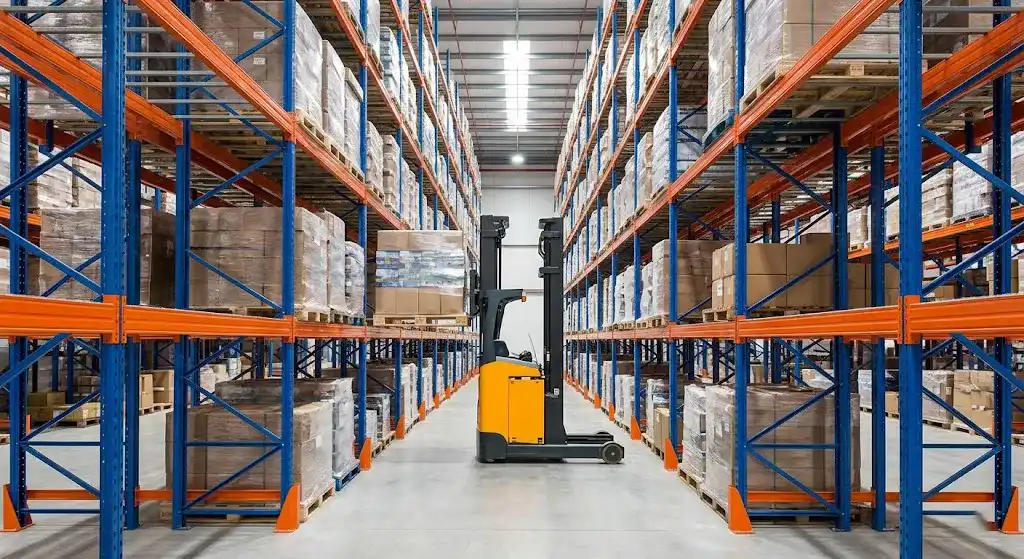
1. Selective Pallet Racking Systems
Selective racking remains the universal standard for warehouses with broad SKU variations requiring immediate 100% pallet access. Built with adjustable beam levels at 50mm, 75mm, or 76.2mm (3-inch) pitch increments, selective systems accommodate standard GMA (40" x 48"), Euro (1200 x 800mm), and Australian standard (1165 x 1165mm) pallets.
Ideal Operational Profile: High-turnover distribution centers, e-commerce picking lines, and facilities utilizing counterbalanced or reach forklifts.
2. Double-Deep & High-Density Drive-In Racking
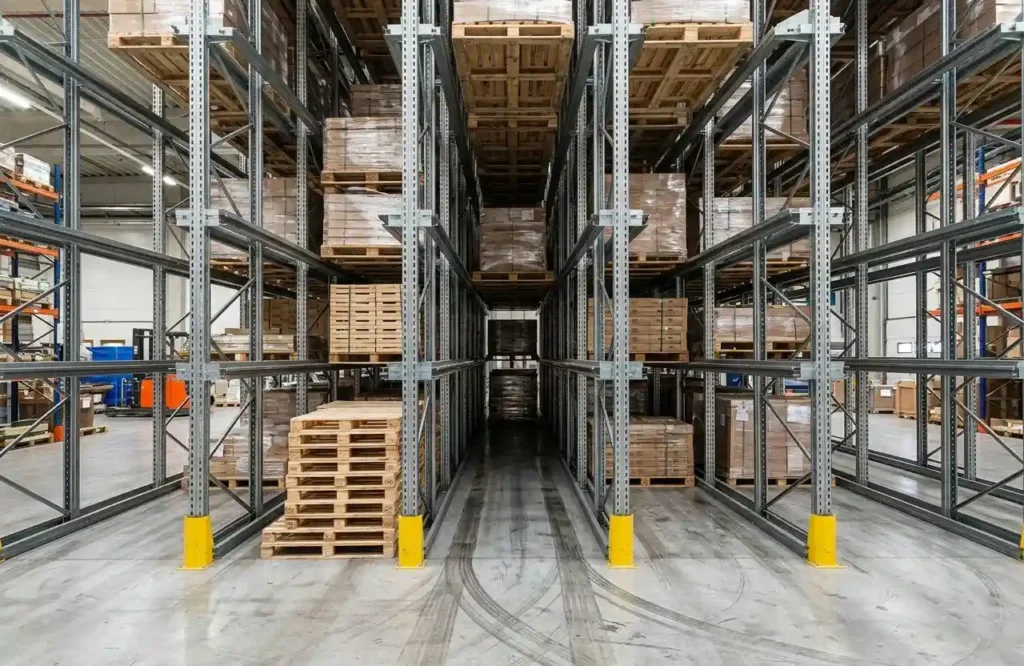
For operations prioritized around volume density over instant selectivity, double-deep and drive-in racking eliminate intermediary aisles. Double-deep systems store pallets two rows deep, requiring deep-reach pantograph forklifts and yielding up to 30% higher cubic utilization than single-selective layouts.
Drive-in and Drive-thru systems allow forklifts to drive directly into structural lanes. Cantilever support arms hold continuous top-hat pallet rails, making this system ideal for high-volume, low-SKU batch storage and temperature-controlled cold rooms.
System Performance & Technical Comparison Matrix
| Racking Architecture | SKU Selectivity % | Cubic Volume Efficiency | Inventory Flow Model | Typical Load Rating (Pair) | Structural Compliance |
|---|---|---|---|---|---|
| Selective Pallet Rack | 100% Direct | Standard (40-50%) | FIFO / LIFO Flexible | 1,000 kg – 4,500 kg | AS4084 / RMI / FEM |
| Double-Deep Racking | 50% Direct | High (60-65%) | LIFO Priority | 1,000 kg – 3,200 kg | RMI ANSI MH16.1 |
| Drive-In / Drive-Thru | Low (Batch) | Very High (75-85%) | LIFO (In) / FIFO (Thru) | 800 kg – 2,000 kg/pos | FEM 10.2.02 / CE |
| Radio Shuttle System | Semi-Automated | Maximum (85-90%) | Software Controlled | 1,500 kg / pallet | ISO 9001 / CE Mark |
| Cantilever & Mezzanines | 100% Open | Specialized Floor | Custom Operational | Up to 6,000 kg/arm | Structural Q355B Code |
Future Procurement & Supply Chain Trends in Industrial Storage
Procurement teams for global enterprises are shifting from short-term spot buying toward strategic OEM supplier partnerships. Based on global logistics data and material cost developments, key trends shape the international procurement of pallet racking:
Container Loading Optimization & Flat-Pack Knock-Down Design
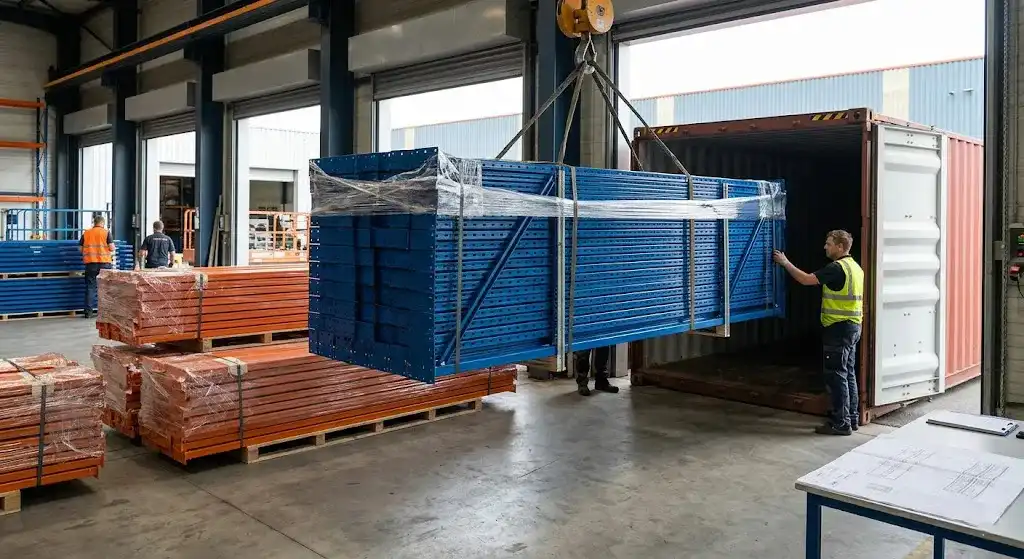
Global sea freight volatility requires maximum volumetric packing efficiency. Engineered knock-down (KD) upright frames enable nested bundle packing, maximizing weight-to-volume ratios in 40ft High Cube containers to lower per-pallet transport costs.
Demand for Rigorous Building Code Compliance & LARC Engineering
Municipal permits in North America, Australasia, and Europe mandate Load Application and Rack Configuration (LARC) engineering drawings certified by professional engineers (PE) to meet regional seismic and soil slab requirements.
Eco-Friendly Surface Coatings & Zero-VOC Finishing
Environmental regulations favor electrostatic epoxy powder coating lines utilizing thermosetting resins. Pre-treatment degreasing and phosphatizing stages ensure adhesion and salt-spray resistance without toxic solvent emissions.
Technological Development Trends: Smart Warehousing & Automation
The industrial storage industry is undergoing a transition from static storage units to automated, intelligent warehousing systems (AS/RS). As an OEM manufacturer, SolidFort engineers rack structures designed to integrate seamlessly with automated material handling equipment:
AS/RS High-Bay Rack Structures & AGV Interface
Automated Storage and Retrieval Systems (AS/RS) require tighter structural tolerances than traditional forklift-operated racking. Upright vertical straightness tolerances must be maintained within 1:1000 ratio over heights exceeding 20 meters.
Furthermore, automated guide vehicles (AGVs) and autonomous mobile robots (AMRs) require obstruction-free floor profiles, recessed anchor baseplates, and guidance rails integrated directly into the lower racking frame.
Key Integration Point: Custom OEM manufacturing allows for pre-punched sensor brackets, cable conduit channels, and precise rack-end bumper integrations required for smart warehouse control systems (WCS).
Why Partner with SolidFort Storage Equipment Co., Ltd.?
Sourcing pallet racking directly from our Xiamen manufacturing facility eliminates intermediary agent markups while ensuring full technical transparency and quality control over raw materials.
In-House Manufacturing Capabilities
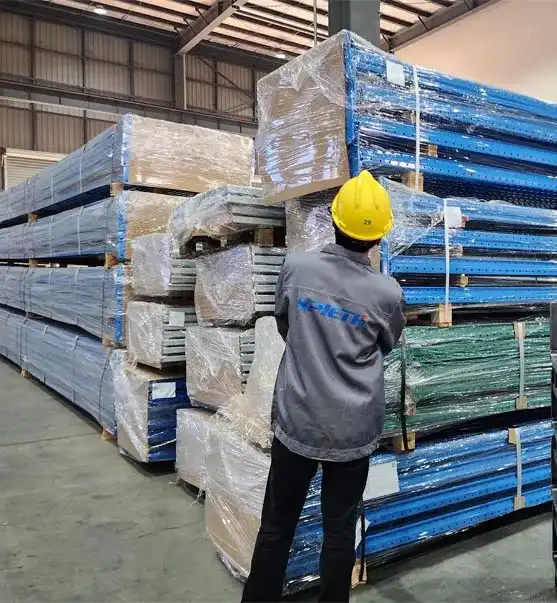
- High-Speed Automated Roll-Forming Lines: Continuous steel profiling ensures precise geometry across column heights up to 12+ meters without splice welds.
- Robotic Welding Workstations: Automated beam claw welding guarantees deep weld penetration and zero human inconsistency.
- Full Quality Traceability: Mill test certificates (MTC) confirm structural yield strengths for every batch of Q235B/Q355B coil steel.
- Comprehensive OEM/ODM Service: Custom colors, hole punch pitches, frame depths, step profiles, and private-label packaging for international distributors.
Frequently Asked Questions (FAQ) for Racking Procurement
Detailed technical answers to common questions asked by warehouse managers, structural engineers, and global buyers.
What does pallet racking cost per pallet position?
Cost depends on raw steel market pricing, load capacity requirements, and system architecture. Standard selective pallet racking typically averages USD 50–100 per pallet position. High-density semi-automated systems such as Push Back, Drive-In, or Radio Shuttle racking range from USD 100–250 per position. These estimates reflect FOB material manufacturing costs; complete project budgets must factor in freight rates, concrete anchor requirements, wire mesh decking options, and localized installation labor.
Do pallet racks need to be anchored to the floor slab?
Yes. Under ANSI/RMI MH16.1, AS4084, and European FEM standards, every single rack column footplate must be securely anchored to the concrete slab. Mechanical wedge anchors or chemical expansion bolts prevent column dislodgement during accidental forklift impacts, stabilize the structure under lateral sway forces, and satisfy building permit seismic resistance parameters. Embedment depth and anchor diameter are determined based on concrete slab thickness (typically 150mm+ minimum) and slab compressive strength (e.g., 3,000 to 4,000 PSI).
How is the structural load capacity of a pallet rack frame calculated?
Pallet rack load rating is defined by two dynamic factors:
1. Beam Pair Capacity: The maximum Uniformly Distributed Load (UDL) a pair of horizontal step/box beams can support without exceeding deflection limits (typically span length divided by 180, i.e., $L/180$).
2. Upright Frame Capacity: Upright capacity is not fixed—it decreases significantly as the unsupported vertical distance between beam levels (unbraced beam height) increases. Frame calculations evaluate maximum combined axial compression load and bending moments. Always follow the engineer-certified Load Application and Rack Configuration (LARC) drawings and display mandatory capacity plaques on bay ends.
What are standard pallet rack dimensions for GMA and Euro pallets?
For standard North American GMA pallets (40" W x 48" D):
• Upright Frame Depth: 42 inches (allowing a standard 3-inch overhang front and back for secure pallet seating on beams).
• Standard Beam Length: 96 inches (8 ft) or 108 inches (9 ft) to hold two pallets side-by-side with required 3-inch to 4-inch side safety clearances.
For Euro Pallets (1200mm x 800mm):
• Upright Frame Depth: 1100mm depth.
• Beam Length: 2700mm beam length holding three Euro pallets side-by-side. Heights are custom roll-formed from 2,000mm up to 12,000mm+.
How frequently should warehouse pallet racking undergo inspection?
According to OSHA guidance and EN 15635 specifications, pallet racking must undergo formal inspection by a qualified structural inspector at least once every 12 months. In addition, internal warehouse operations should conduct weekly or monthly visual walkthroughs to identify bent column footings, missing safety beam pins, dynamic forklift impact deformities, or overloaded beam deflections. Any damaged component must be offloaded immediately and replaced with certified OEM components.
What is the standard manufacturing lead time and export delivery term options?
Standard OEM production run lead time at our Xiamen plant is 10 to 15 business days from deposit approval. Complex engineered projects requiring custom structural profiles or specialized hot-dip galvanizing take approximately 25–30 days. We support international commercial trade terms including FOB (Xiamen Port), CIF, CFR, and DDP (Delivered Duty Paid), complete with full customs documentation and professional container loading diagrams.