1. Architectural Engineering & Structural Dynamics of Back-to-Back Pallet Racking
In modern supply chain logistics and industrial warehousing, space optimization is no longer merely a metric of floor coverage; it is a structural engineering challenge. As a top trusted back-to-back pallet racking factory and supplier, SolidFort Storage Equipment Co., Ltd. manufactures high-density storage frameworks designed to bridge the gap between traditional selective accessibility and ultra-dense storage ratios.
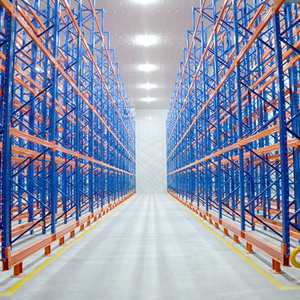
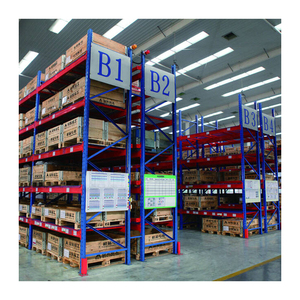
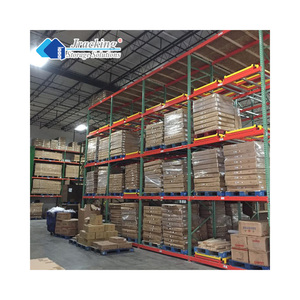
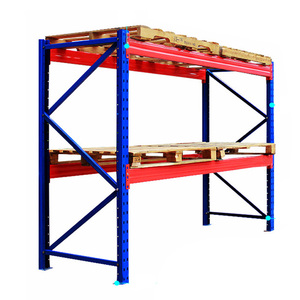
A standard Back-to-Back Pallet Racking System is constructed by placing two single rows of selective pallet racks back-to-back, connected mechanically using structural steel row spacers. This configuration eliminates intermediate aisle spaces that would otherwise be consumed by material handling equipment (MHE), creating a unified structural block accessed via parallel operating aisles. By effectively doubling the depth of the storage array without introducing complex mechanical automated components, facilities gain an immediate 35% to 45% increase in cubic space utilization compared to isolated single-row layouts.
Structural Tie-In Mechanics
Rigid row spacers tie adjacent upright frames into a unified structural matrix, vastly increasing lateral stiffness and buckling resistance under asymmetrical impact loads.
Flue Space Integrity
Engineered row spacers guarantee uniform 6-inch to 12-inch longitudinal flue spaces compliant with NFPA 13 fire suppression protocols and heat dissipation mandates.
High-Grade Q235 / Q355 Steel
Cold-rolled structural steel profiles with continuous roll-forming tolerances ensure superior section modulus and long-term structural resilience against frame deflection.
From a structural mechanics standpoint, back-to-back frame assemblies benefit from combined moment distribution. Single racking runs are inherently susceptible to out-of-plane sway buckling along the cross-aisle direction under severe loading or sudden MHE strikes. When two frames are linked via bolted structural row spacers, the effective unbraced length ($L_{x}$) along the transverse axis is stabilized by the opposing frame. This cross-bracing interaction improves sway stability, permitting higher top-beam elevations—exceeding 12 to 15 meters in engineered high-bay distribution centers—without compromising structural safety factors defined by RMI (ANSI MH16.1) and AS4084-2012 standards.
Information Gain Insight: Flue Space Optimization & Fire Compliance
A critical engineering nuance often overlooked in cheap rack designs is the maintenance of flue space. SolidFort's engineered back-to-back row spacers incorporate mechanical positive-stop locks that prevent pallet over-travel into the flue space. This maintains vertical sightlines for automated early suppression fast response (ESFR) ceiling sprinklers, ensuring compliance with global FM Global and NFPA fire safety standards without requiring costly in-rack sprinkler installations in mid-bay heights.
2. Comprehensive Structural Specifications & Performance Parameters
Precision engineering requires rigorous material selection and dimensional accuracy. Every component produced at SolidFort's 30,000 m² Xiamen manufacturing plant undergoes structural stress modeling using finite element analysis (FEA) to verify yield strengths, horizontal beam deflection limits ($L/240$), and axial compression limits of cold-formed upright profiles.
| Component Element | Technical Profile / Specification | Material Standard | Load / Engineering Parameter |
|---|---|---|---|
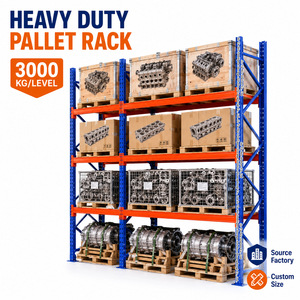
| Upright Frame Profiles | 80×60, 90×70, 100×70, 120×95 (mm) teardrop/omega profiles | Q235B / Q355B Cold Rolled Steel | Up to 24,000 kg structural frame capacity |
| Box Step Beams | 80×50 to 160×50 (mm) interlock dual-C beam profile | High-Tensile Cold Formed Steel | 1,000 kg – 4,500 kg per level pair ($L/240$ deflection) |
| Row Spacer Ties | C-Channel / Tubular structural steel spanning 200–450 mm | Heavy-Gauge Galvanized Q235 | Rigid mechanical tie-in; maintains constant flue gap |
| Beam End Connectors | 3, 4, or 5-hook heavy-duty welded connector brackets | Drop-Forged Steel Plate | Self-locking safety pins prevent accidental dislodgement |
| Surface Finish | Thermosetting Epoxy-Polyester Powder Coating (80-100 μm) | ISO 9001 / CE Certified | High anti-corrosion, impact resistant, scratch-proof |
The interaction between the step beam connector and the upright column slot is pivotal to overall system rigidity. SolidFort utilizes precision-punched teardrop and omega slot patterns with tapered engagement pins. As beam loading increases, the connector hooks wedge tighter into the column profile, creating a semi-rigid joint dynamic that dampens horizontal sway. Safety locking pins made of zinc-plated spring steel are installed into every beam end plate as a standard safety protocol, preventing beam dislodgement caused by upward forklift mast snagging.
3. Strategic Purchasing Trends in Industrial Pallet Storage Systems
The international warehousing and logistics market is undergoing a seismic shift driven by skyrocketing commercial real estate costs, e-commerce proliferation, and strict workplace safety mandates. Industrial procurement directors are changing how they evaluate, source, and deploy back-to-back pallet racking systems globally:
1. Shift Toward Double-Deep & Reach Truck Hybridization
Buyers are moving away from simple single-deep racking toward double-deep back-to-back configurations. Utilizing pantograph reach trucks, double-deep back-to-back racks eliminate every second aisle, unlocking up to 30% additional storage density without sacrificing system simplicity.
2. Strict Demand for Multi-Standard Certification
Multinational 3PL operators demand racking suppliers whose structural calculations align simultaneously with European FEM 10.2.02, American RMI ANSI MH16.1, and Australian AS4084 standards, enabling global deployment of standardized warehouse blueprints.
3. Factory-Direct Sourcing & Rapid Lead Time
Supply chain volatility has prioritized suppliers with fully integrated, in-house roll-forming mills, automated robotic welding lines, and guaranteed 10–15 day turnaround times, eliminating broker delays and unvetted sub-contracting risk.
4. Integrated Protection & Life-Cycle Safety
Industrial buyers now mandate comprehensive protective add-ons—such as heavy-gauge steel column protectors, row end guards, and drop-over mesh decks—directly within initial supply contracts to eliminate expensive aftermarket safety retrofits.
4. Future Development Trends: Automation Integration & Smart Racking
The evolution of industrial storage lies at the intersection of static structural design and dynamic warehouse automation. As artificial intelligence, autonomous mobile robots (AMRs), and Automated Storage and Retrieval Systems (AS/RS) mature, back-to-back pallet racking is evolving into an active participant in digital logistics ecosystems:
A. Hybrid Push-Back & Radio Shuttle Back-to-Back Arrays
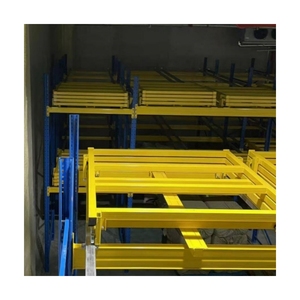
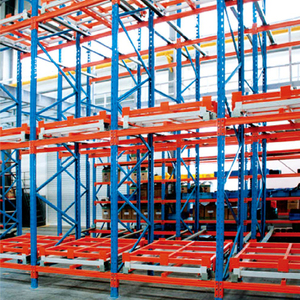
Future warehouse architectures are replacing standard static beam levels within back-to-back configurations with dynamic nesting push-back cart channels or semi-automated radio shuttle tracks. In these advanced systems, double back-to-back frames house autonomous shuttles that transport pallets deep into multi-position lanes. This hybrid model achieves storage densities approaching 85% volumetric efficiency while retaining fast pallet retrieval speeds across high-turnover SKUs.
B. Micro-Deflection & Structural Health Monitoring (IIoT)
The future of rack safety is smart, connected infrastructure. Next-generation back-to-back frames are beginning to integrate strain gauges and IIoT micro-deflection sensors embedded at high-stress upright junction nodes. These sensors provide real-time telemetry on structural overloading, uneven load distributions, or unrecorded forklift impact damage, alerting safety managers via cloud dashboards before catastrophic structural collapse occurs.
C. Advanced High-Tensile Steel & Sustainable Eco-Coatings
Metallurgical advancements are pushing cold-rolled steel profiles toward higher yield strengths (such as Q355B and Q460 micro-alloyed steel). By utilizing thinner, higher-strength profiles, manufacturers reduce steel tonnage requirements without sacrificing load capacity, yielding a smaller carbon footprint during transport. Furthermore, solvent-free, heavy-metal-free electrostatic powder coatings are replacing traditional solvent paints, satisfying stringent international ESG (Environmental, Social, and Governance) procurement metrics.
5. Why Choose SolidFort: Manufacturing Powerhouse & Corporate Advantages
Operating from a state-of-the-art 30,000 square-meter production facility in Tongan Park, Tongan District, Xiamen, China, SolidFort Storage Equipment Co., Ltd. stands out as a Premier OEM/ODM Pallet Racking Manufacturer and global exporter serving over 53 countries across North America, Europe, Australia, and Southeast Asia.
State-of-the-Art Production Mills
Equipped with 12 automatic continuous roll-forming production lines, robotic laser cutting stations, and automated dual-line powder coating chambers capable of processing over 3,000 tons of structural steel monthly.
Full Engineering & Free CAD Support
Our experienced structural engineering team provides complimentary 2D floorplan CAD layouts, 3D structural renderings, dynamic load calculations, and LARC (Load Application & Rack Configuration) plaques with every quote.
Unrivaled Quality Assurance
ISO 9001 certified quality control covering raw coil tensile testing, weld seam ultrasonic inspections, powder adhesion cross-hatch testing, and pre-shipment container trial-assembly checks.
Whether you are a rack system distributor, warehouse project contractor, logistics integrator, or facility end-user, SolidFort provides direct factory pricing, zero middleman markups, flexible minimum order quantities (MOQ), and transparent FOB, CIF, or DDP shipping terms with detailed container loading optimization.
6. Frequently Asked Questions: Structural, Procurement & Installation
Cost per pallet position is determined by structural height, beam weight capacity, steel market pricing, and accessory choices. Standard selective back-to-back pallet racking typically averages USD $45 to $85 per pallet position for material supply. High-density deep reach or push-back variants can range from USD $100 to $220 per position. These estimates generally cover steel materials; freight, engineering stamps, and installation vary based on site location.
Row spacers serve three critical structural functions: First, they lock two parallel single rows together into a unified structural block, significantly raising cross-aisle sway rigidity and frame stability. Second, they enforce a uniform longitudinal flue space required by building fire codes (ANSI/NFPA 13) for sprinkler water penetration. Third, they prevent frame twist and misalignment during loading and unloading operations.
Yes, absolutely. Under RMI ANSI MH16.1, AS4084, and FEM guidelines, every baseplate of every rack column must be anchored firmly to the concrete slab using heavy-duty expansion or wedge anchors. Floor anchoring resists base rotation, prevents displacement from accidental MHE impact, handles overturning moments caused by high-level pallet loading, and ensures seismic resistance according to regional seismic design categories.
Frame load capacity is not a static number stamped on an upright profile; it is a calculated value based on the maximum vertical unbraced beam distance (beam level spacing). As vertical beam spacing increases, the column bucking resistance decreases. Beam pair capacity is calculated assuming a uniformly distributed load (UDL) limited by an allowable vertical elastic deflection of length divided by 240 ($L/240$). Always consult SolidFort's engineered Load Application and Rack Configuration (LARC) drawings for your specific bay configuration.
For standard North American 40×48 inch (1016×1219 mm) GMA pallets: Standard upright frame depth is 42 inches (1067 mm), providing a recommended 3-inch overhang on both the front beam and rear beam. Standard beam length for holding two pallets per level is 96 inches (2438 mm) or 108 inches (2743 mm) for heavy clearances. For Euro pallets (1200×800 mm or 1200×1000 mm), frame depths of 1100 mm and beam lengths of 2700 mm are typically manufactured.
SolidFort maintains standard production lead times of 10 to 15 days for standard selective and back-to-back rack orders, and approximately 30 days for complex engineered automation structures. We support all international Incoterms including EXW, FOB, CIF, CFR, and DDP (Delivered Duty Paid directly to your facility door). Every container shipment includes a custom 3D container packing plan to ensure maximum container space usage and prevent transit damage.